If every possible universe exists, then why doesn’t our universe fly apart?
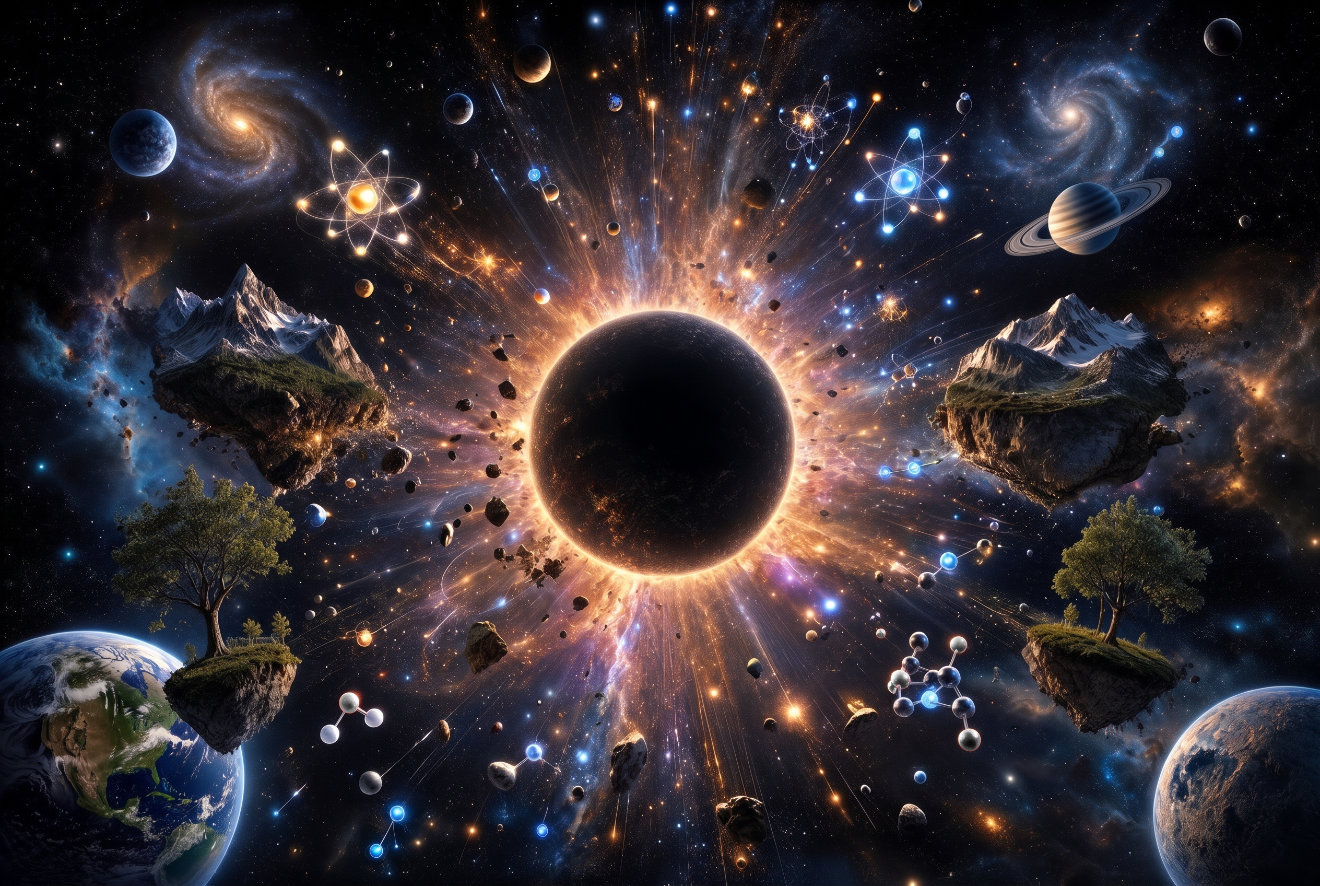
I mean, if every possible universe exists, then one possible universe is the one in which everything holds together, right up to this moment, when everything flies apart.
Why are we in this universe, where everything continues to hold together, rather than that universe, where, at the moment you least expect it, everything flies apart?
There’s an obvious answer to this question.
Universes that fly apart do exist, but they’re too chaotic for intelligent life to evolve, so there’s no one there to observe them.
This thesis is a variation of the Anthropic Principle: the idea that we’re in the universe we’re in because if it weren’t precisely the way it is then we wouldn’t be here.
If there’s only one universe, then the Anthropic Principle is nonsense: it’s just another argument from design.
But if every possible universe exists, then a variation of the Anthropic Principle could make sense.
Here’s why it’s wrong.
Keep it together
In the Wolfram model, the universe is a hypergraph:

which evolves through the application of rules:

According to Stephen Wolfram, every possible rule is applied to the hypergraph in every possible way.

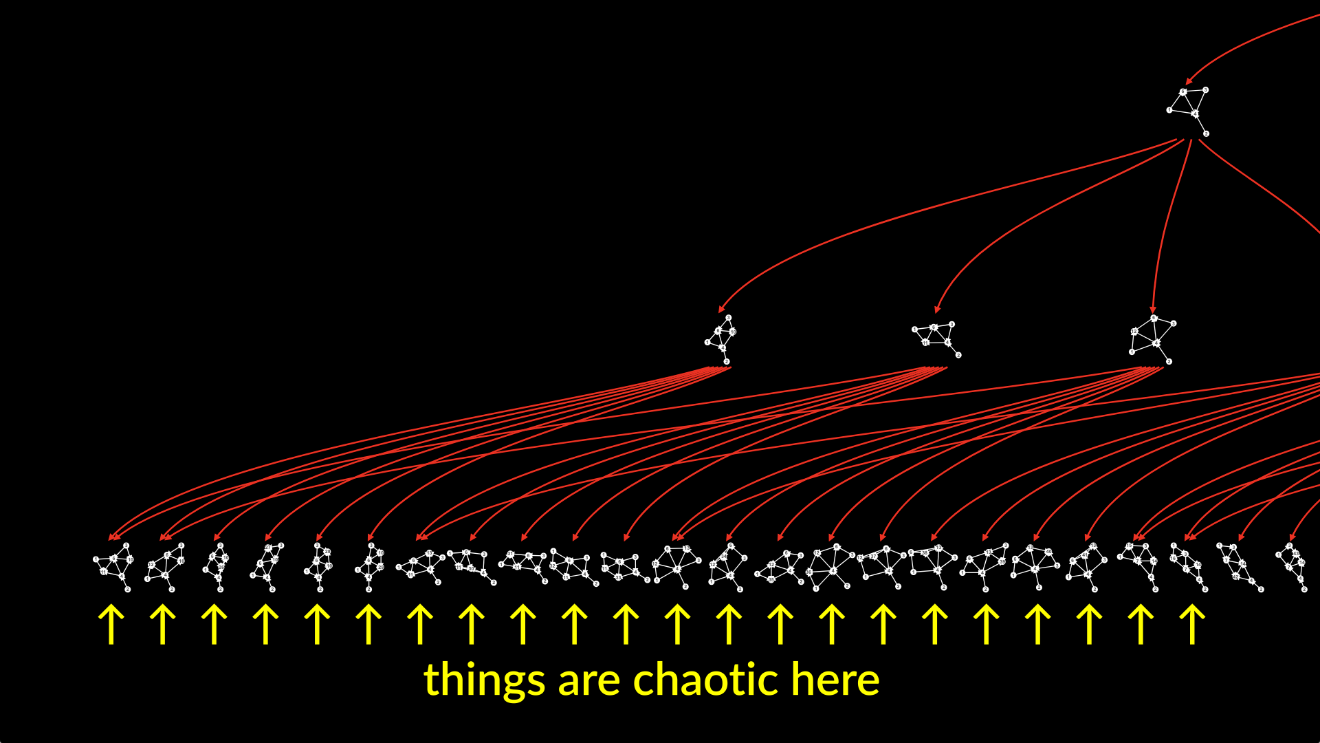
At every moment, the universe branches into a squillion universes where things are chaotic:
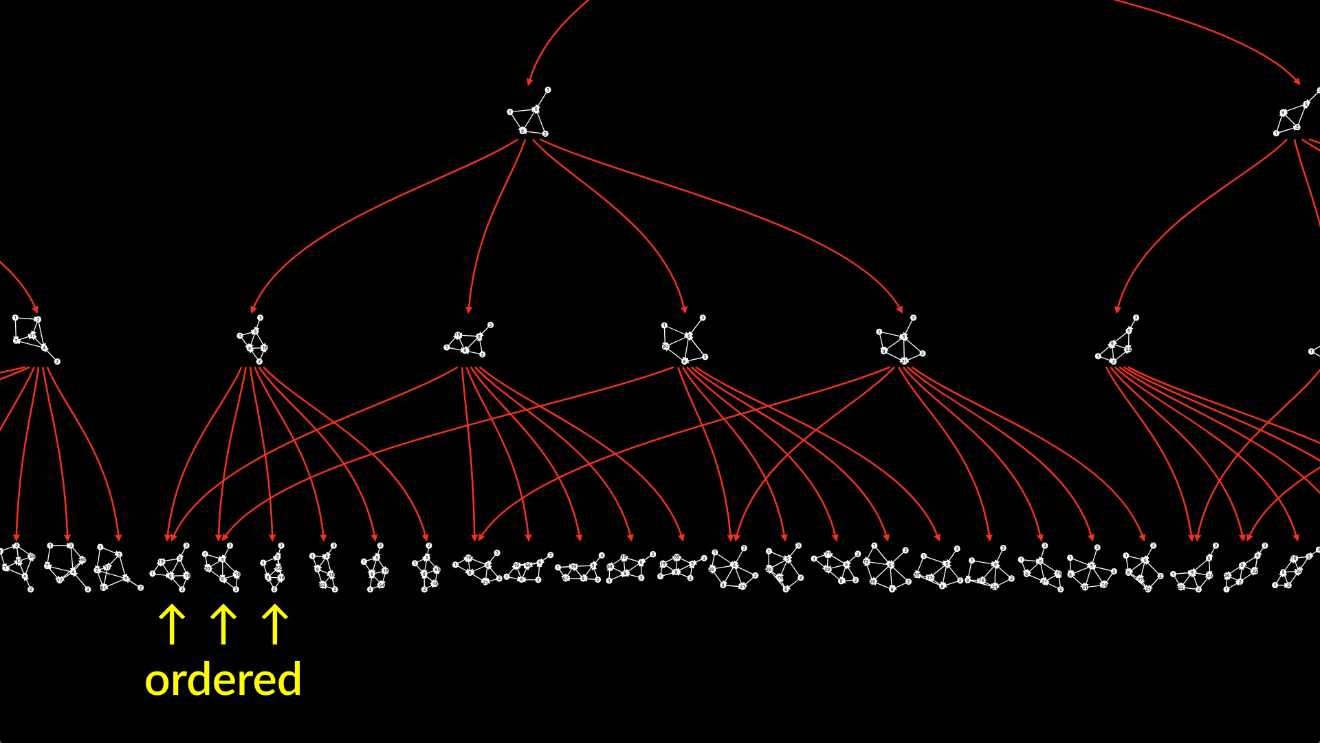
and a smaller number of universes in which things are ordered:
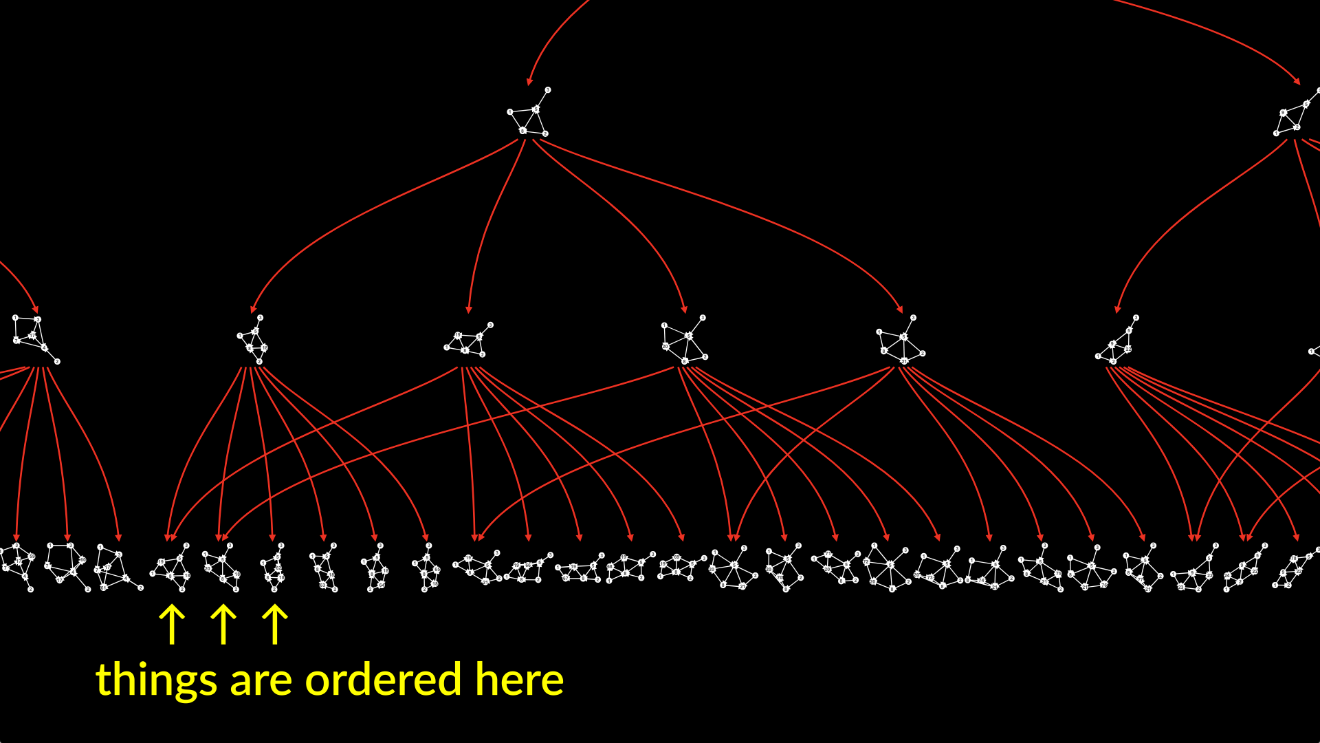
In the ordered universes, everything happens according to the laws of physics, consistently, every time: electrons persist, molecules are stable and mountains, well, mountains don’t do much.

In the chaotic universes, there are no laws of physics: electrons degenerate, molecules detonate and mountains dematerialize.

If, by some miracle, the nodes and edges of the hypergraph happen to form anything as coherent as an electron in any one instant, it’ll degenerate into something incoherent in the next instant.
After all, we’re applying every possible rule in every possible way, including all the applications of rules in ways that would cause the electron to degenerate... which is most of them. As anyone who has ever played with building blocks knows, it’s much easier to take things apart than to put them together.
And if electrons don’t persist from one instant to the next, then there’s no possibility of atoms persisting from one instant to the next, or molecules, or_mountains_... or us.
There are no observers in these chaotic universes: we could not have evolved as humans if the laws of physics had not remained consistent over billions of years.
So, again, why are we in this universe, which doesn’t fly apart, rather than one of those other universes, which do fly apart?
Let’s take a closer look at that obvious answer to this question: universes that fly apart do exist, but there’s no one there to observe them.
Knife edge
The problem with this way of thinking is that the chaotic universes vastly outnumber the ordered universes.
Given that it’s much easier to take things apart than to put them together, the ordered universes are not just rare, they’re so rare as to be... well, there are no words for how rare they are.
Nonetheless, I’m in an ordered universe. I know I am. The sun rises every day.

Every day.
Things persist. That tree:

will still be there in a moment’s time. There, I told you so, it’s still there:
And it’ll still be there in another moment’s time. There, I told you so, it’s still there:
In this universe, mountains never suddenly dematerialize. Never. Electrons persist. Trees persist. Mountains persist. I persist.
I find myself at a truly extraordinary point in the multiway graph:
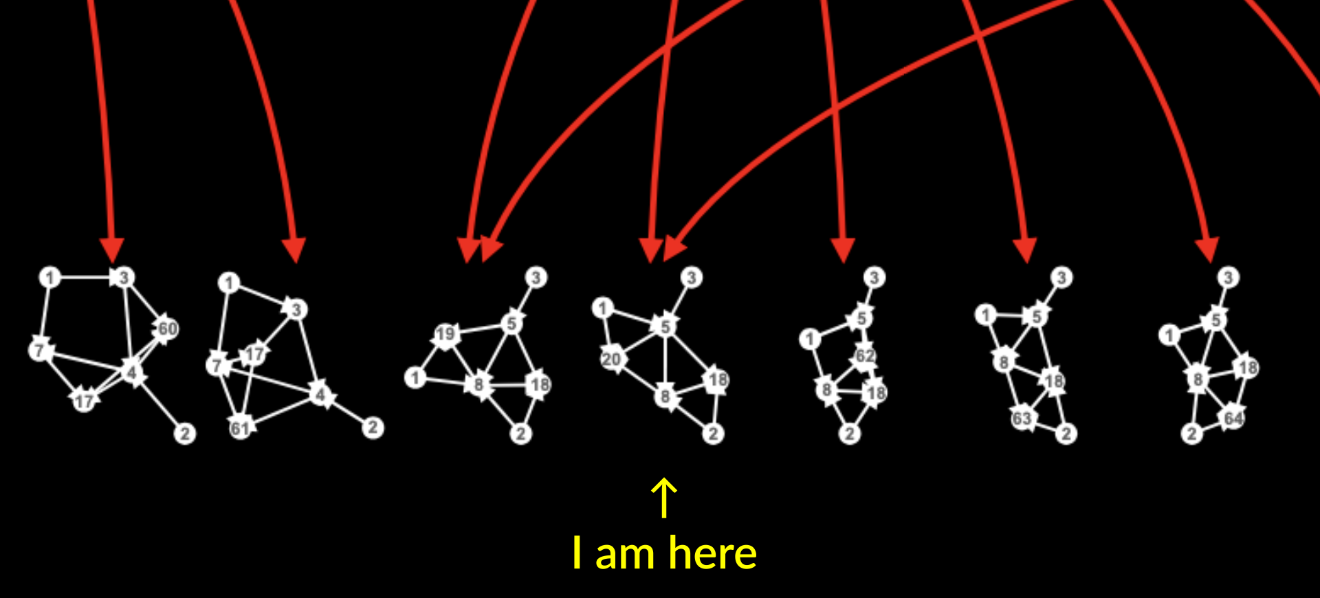
At every branching of the multiway graph that led to this point, going right back to the beginning of time, a rule was applied to the hypergraph in a way that maintained the coherence of electrons and everything else, rather one of the vastly more numerous other ways that would have undermined the coherence of electrons and everything else.
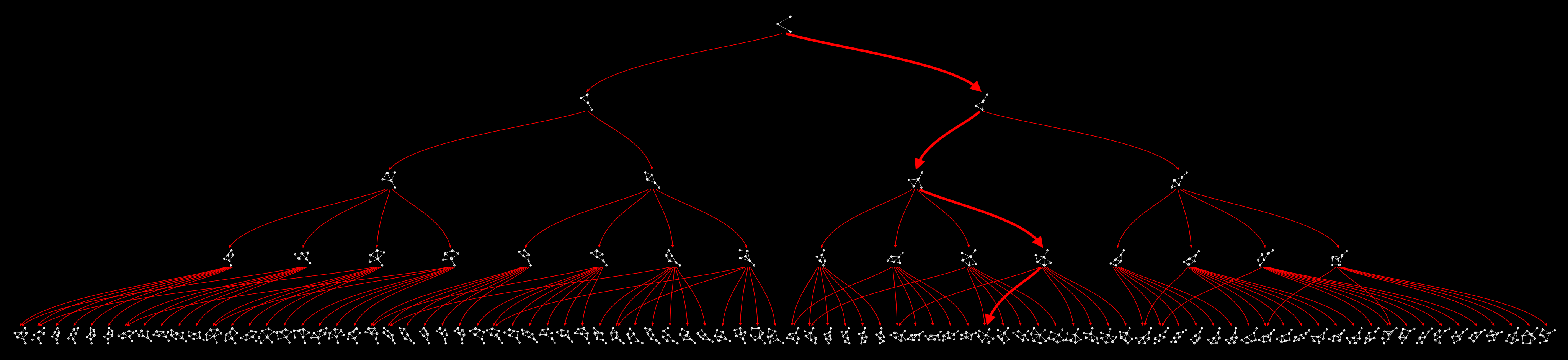
That’s looking back through the multiway graph.
Now let’s look ahead.
From this extraordinary point in the multiway graph, almost all of the possible applications of rules to the hypergraph would blow my universe to smithereens. Electrons would degenerate. Trees would disintegrate. Mountains would dematerialize. I would disappear.
Just as there’s a knife edge of a path through the multiway graph leading to this extraordinary point at which the universe is ordered – and has been ordered since the beginning of time – so there’s a knife edge of a path through the multiway graph ahead of this extraordinary point along which the universe remains ordered until the end of time.
Either side of that knife edge, the universe collapses into chaos.
Chaos rules
I know what you’re thinking: if the path ahead does deviate from this knife edge, then I won’t be around to observe it. Only at the points along that knife edge of a path ahead through the multiway graph will I be around to experience the persistence of the trees and the mountains.
But think about this:
If, at every branch in the multiway graph, there are a squillion possible applications of the rules that undermine the coherence of electrons and everything else, and a smaller number of possible applications of the rules that maintain the coherence of electrons and everything else, then isn’t there also some middling number of possible applications of the rules that give rise to a universe that’s neither entirely chaotic nor entirely ordered, but somewhere in between?
It’s not hard to imagine a universe where electrons persist most of the time. If this universe were to be anywhere near as ordered as my universe, electrons would have to be stable enough for atoms to persist most of the time, and atoms would have to be stable enough for molecules to persist most of the time, and molecules would have to be stable enough for life to evolve.
Again, given that it’s much easier to take things apart than to put them together, just as there are squillions of times more chaotic universes:
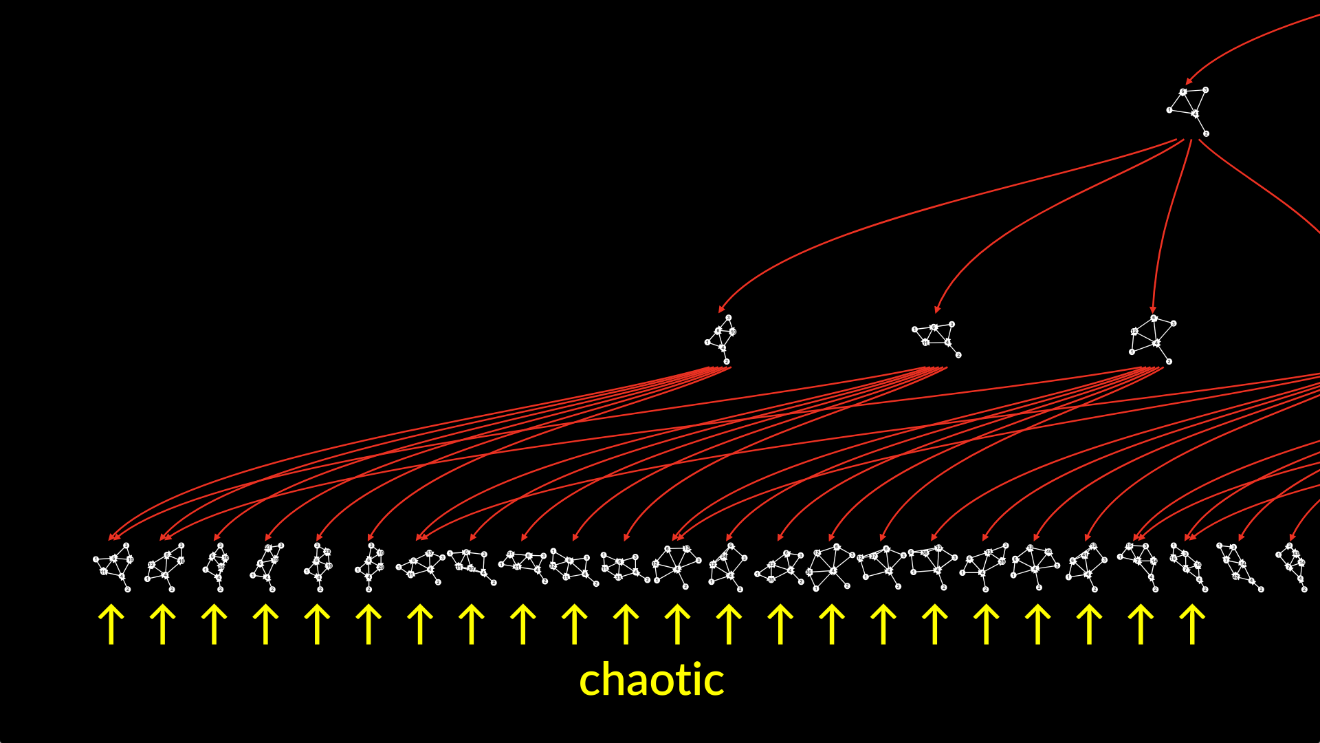
than ordered universes:
there would similarly be squillions of times more mostly ordered universes:
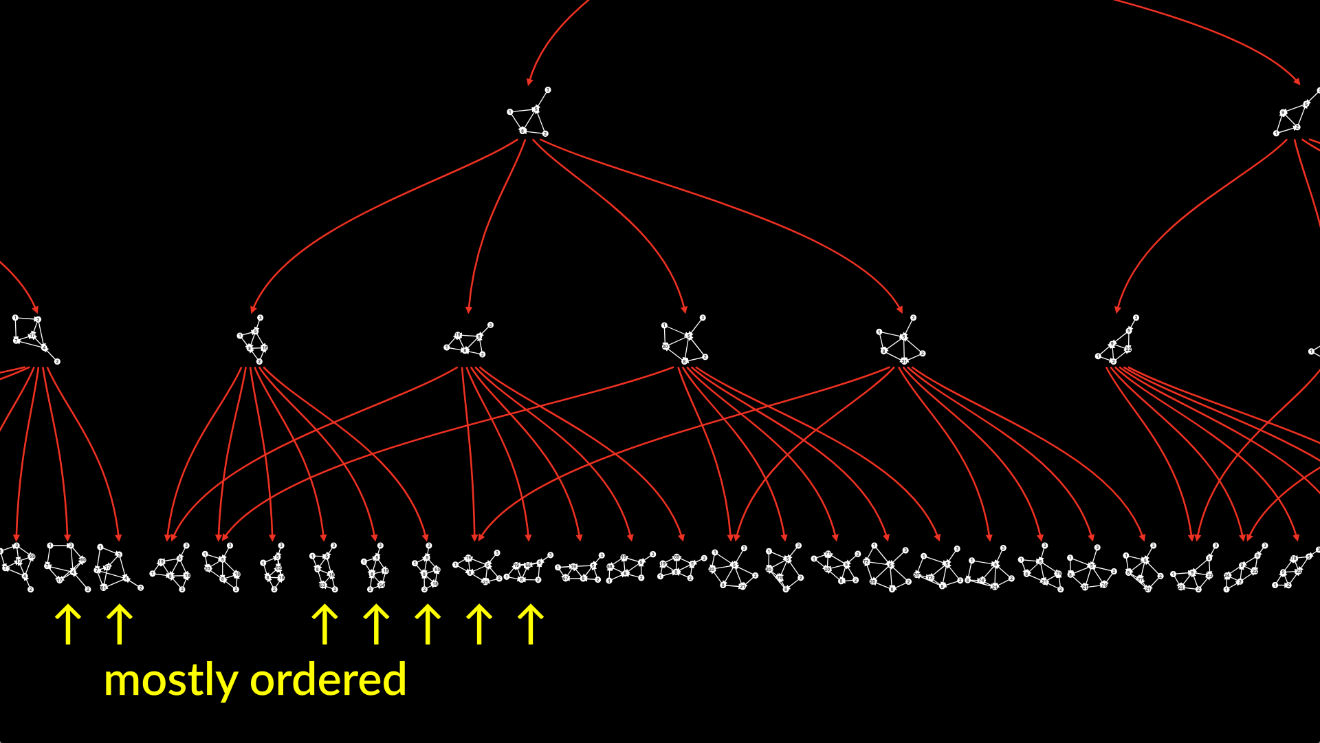
than entirely ordered universes:
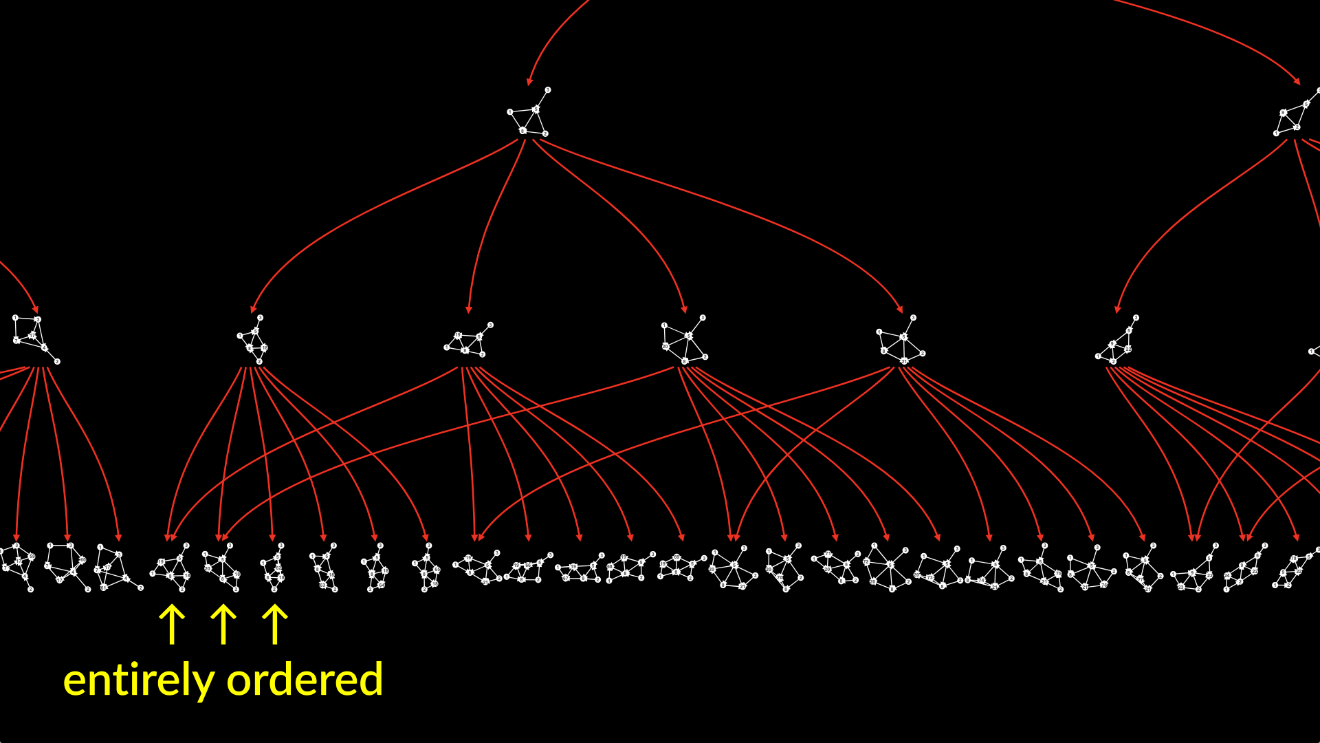
So why don’t we live in one?
Peculiarly persistent
I might be kidding myself, but it seems to me that my universe is entirely ordered. Here, electrons persist, not just most of the time, but all of the time.
How do I know this?
Well, sorry to resort to evidence, but physicists have actually taken a look at this. The Standard Model predicts that electrons live forever. Unperturbed by the theoretical physicists’ certainties, experimental physicists have tried to measure how long electrons live. Their answer is: at least 66,000 yottayears.
That’s a very long time.
Let’s put this in context. The universe is only 13.8 billion years old. That means that of all the electrons that have ever existed, at least 99.999 999 999 999 999 99% of them have persisted through the entire history of the universe.
That’s pretty much all of them.
In my universe, electrons persist, not just most of the time, but all of the time.
Why?
Why do we never see an electron degenerate?
I mean, a mostly ordered universe, in which the occasional electron degenerates, would surely be ordered enough for intelligent life to evolve.
Thousands of neurons in my brain die every time I hit my head, and I’m still intelligent – or, at least, not entirely empty-headed – so I’m sure intelligent life could survive, say, an electron degenerating somewhere in the universe once every yottayear or so.
If there are squillions of times more mostly ordered universes, in which the occasional electron degenerates, than entirely ordered universes, in which electrons never degenerate, why do we find ourselves in one of the rare entirely ordered universes, rather then one of the squillions of times more common mostly ordered universes?
For me, this question casts serious doubt on the idea that chaotic universes do exist, but there’s no one there to observe them.
Our universe is so ordered – at least 99.999 999 999 999 999 99% ordered when it comes to the persistence of electrons – that it’s hard for me to swallow the idea that it’s forever devolving into more chaotic universes where observers like me instantly disappear... or, in some universes, slowly disappear.
It’s not all about us
The Anthropic Principle is wrong.
If only one universe exists, then it’s an argument from design. You can’t argue that the universe is the way it is because it’s perfectly designed for us without arguing that the universe is designed.
If every possible universe exists, then the Anthropic Principle is still wrong.
If, as Stephen Wolfram proposes, every possible rule is applied to the hypergraph in every possible way, then a vanishingly small fraction of these possible universes are ordered enough to support observers:
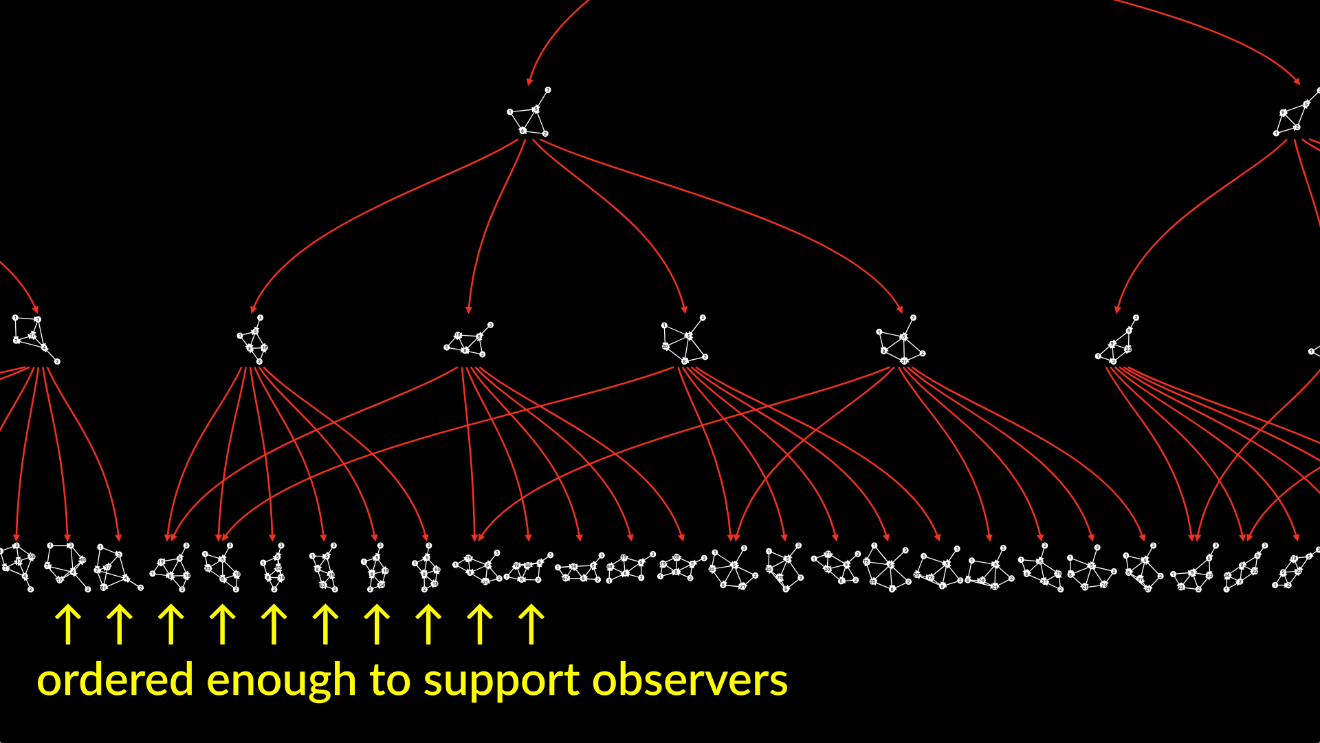
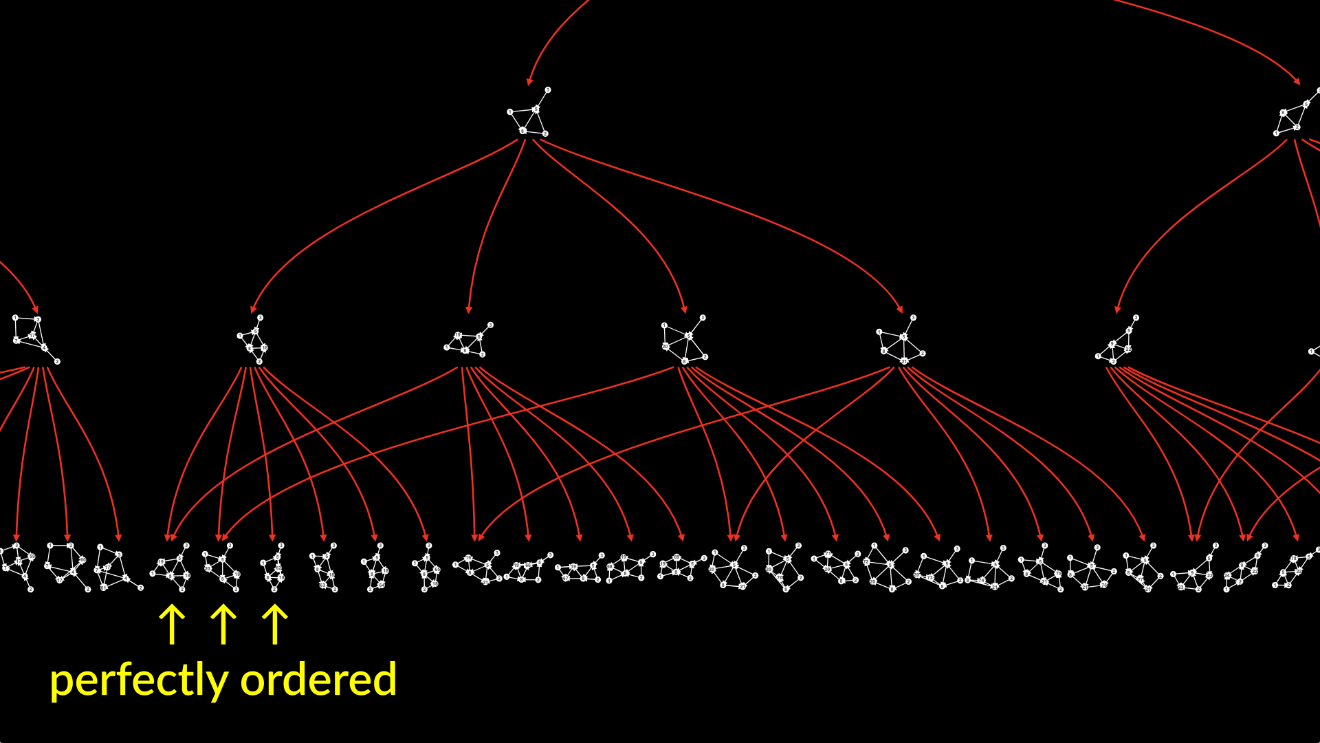
and a vanishingly small fraction of that vanishingly small fraction are perfectly ordered:
It’s no coincidence that we find ourselves in one of the vanishingly small fraction of universes that are ordered enough to support observers. We are observers. We couldn’t possibly find ourselves in a universe that’s not ordered enough to support observers.
However, it is a coincidence that we find ourselves in one of the vanishingly small fraction of that vanishingly small fraction of universes that are perfectly ordered.
Too much of a coincidence.
We don’t find ourselves in a universe in which electrons rarely degenerate.
We find ourselves in a universe in which electrons never degenerate.
That’s a reality that the Anthropic Principle can’t explain.
Another answer
I think there’s something else going on.
In the next two articles in this series, I’ll be considering two much better answers to the question of why we’re in the universe we’re in.
One is Stephen Wolfram’s thesis: we observe the universe we observe because we are the observers we are.
The other answer posits that not every possible universe exists, that there are probabilistic laws of physics that determine which universes do exist and which don’t.
These are two fundamentally different worlds.
Which one is our world remains to be seen.