If physics is computational, then what gets computed when?
Maybe the left side of me gets computed first...
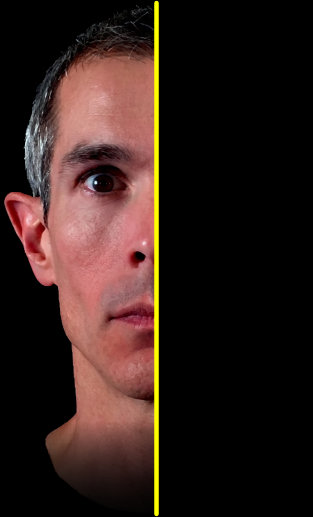
...and the right side of me gets computed second.

More likely, all of me gets computed evenly.
But why?
This is a surprisingly deep question.
The seemingly even computation of the universe gives us a clue, not just to the nature of time, but to the nature of the universe.
And it leads us to a wider question:
Why are we in the universe we’re in?
Let me introduce you to three different answers to that question...
...so different that they don’t even agree on whether one universe exists...
...or every possible universe exists.
The clue
This somewhat simplified visualization of a pulsar and an astronomer’s brain in the hypergraph:
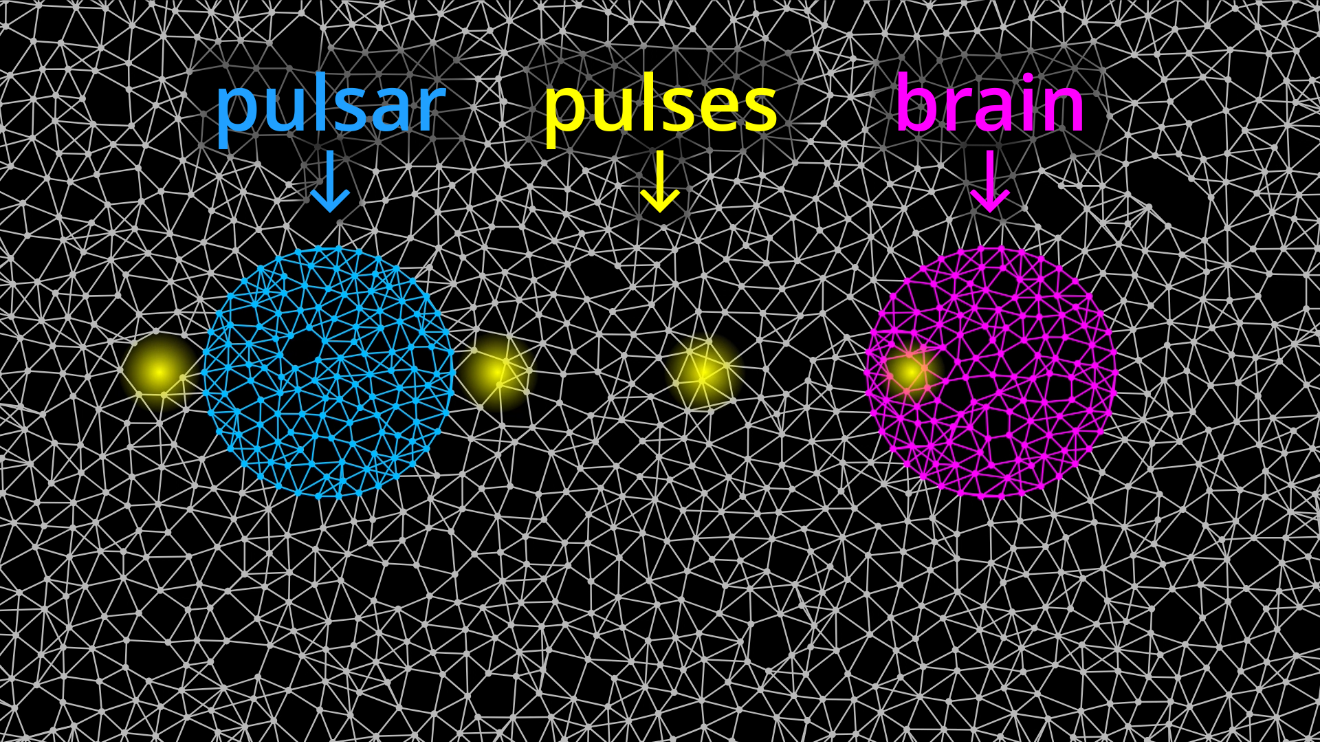
holds a clue, not just to the nature of time, but to the nature of the universe.
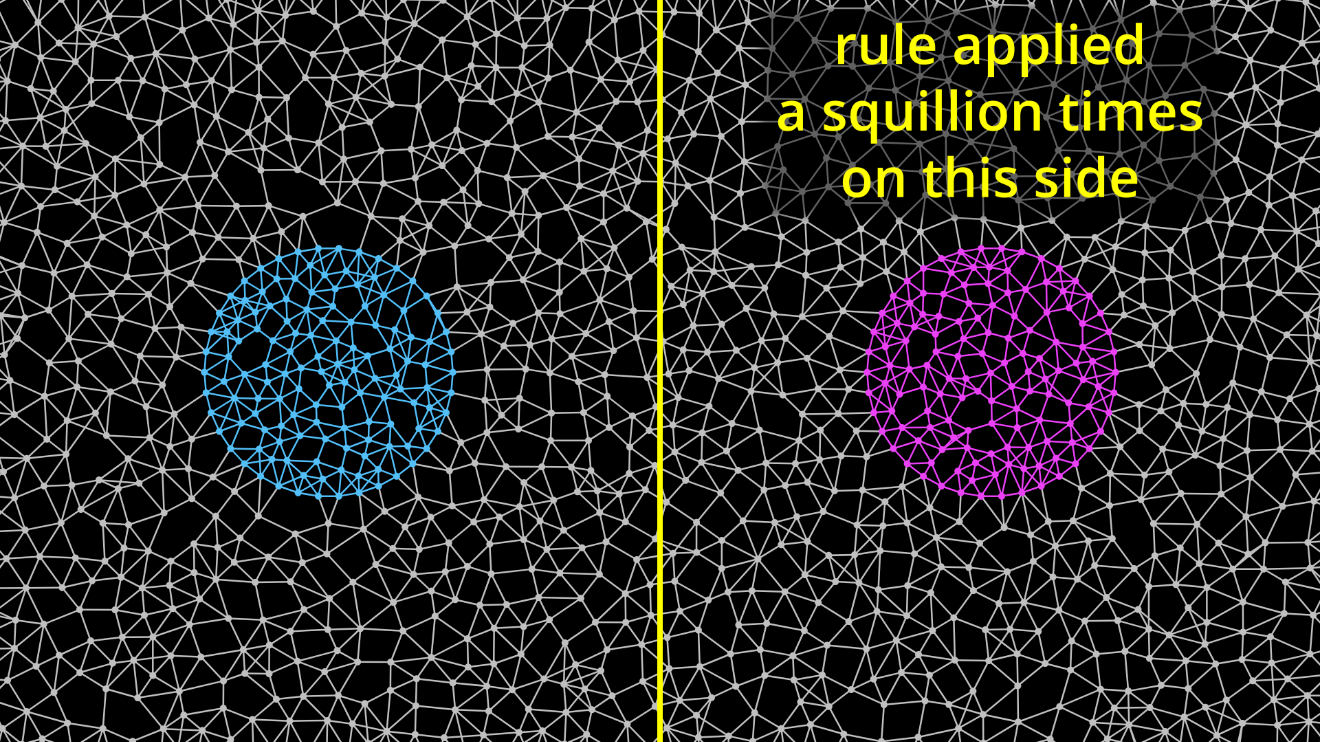
The pulsar – the blue circle on the left – emits pulses of radiation, which make their way across the universe to a radio telescope and into the astronomer’s brain – the purple circle on the right.



Applying rules to the nodes and edges of the hypergraph gives rise to all the activity in the universe: the rotation of the neutron star, the emission of the pulses from its magnetic poles, the propagation of the pulses through space, the detection of the pulses at the radio telescope and the perception of the pulses by the astronomer.
Here’s the clue.
Every time I apply a rule to the hypergraph, I select the nodes and edges to which I’m going to apply it randomly, from all the nodes and edges across the universe.
I could, instead, apply rules a squillion times in a row to the nodes and edges on the pulsar’s side of the universe:
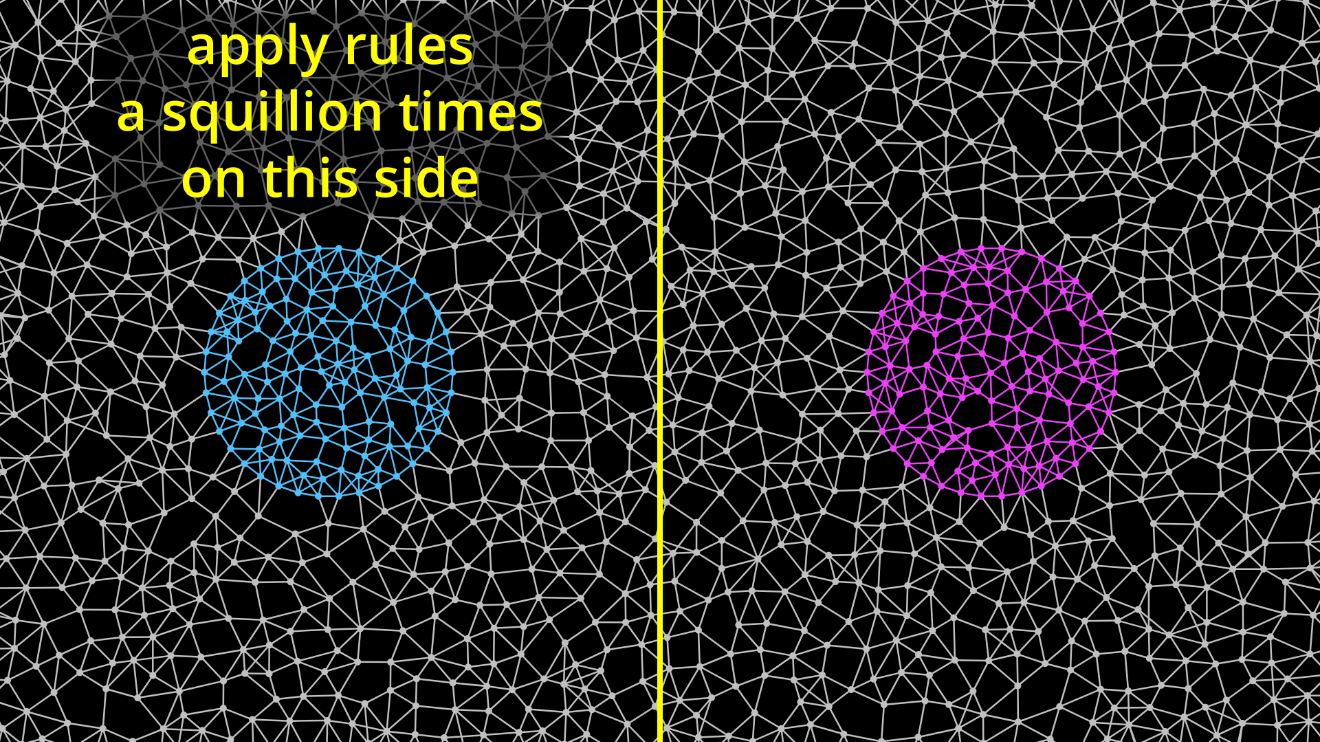
then apply rules a squillion times in a row to the nodes and edges on the astronomer’s side of the universe:
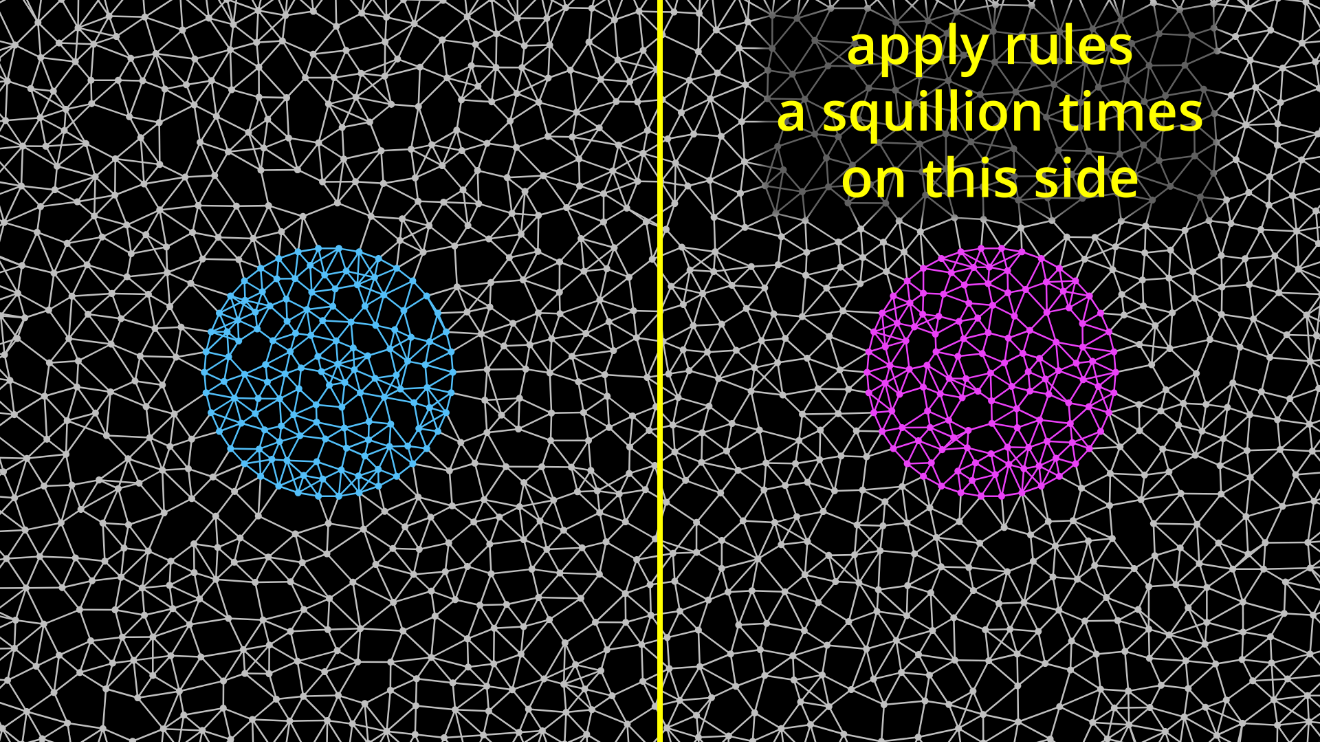
But you can see what would happen if I did.
The pulsar would emit a squillion pulses of radiation, while the astronomer’s brain remained frozen.
The squillion pulses would accumulate here:
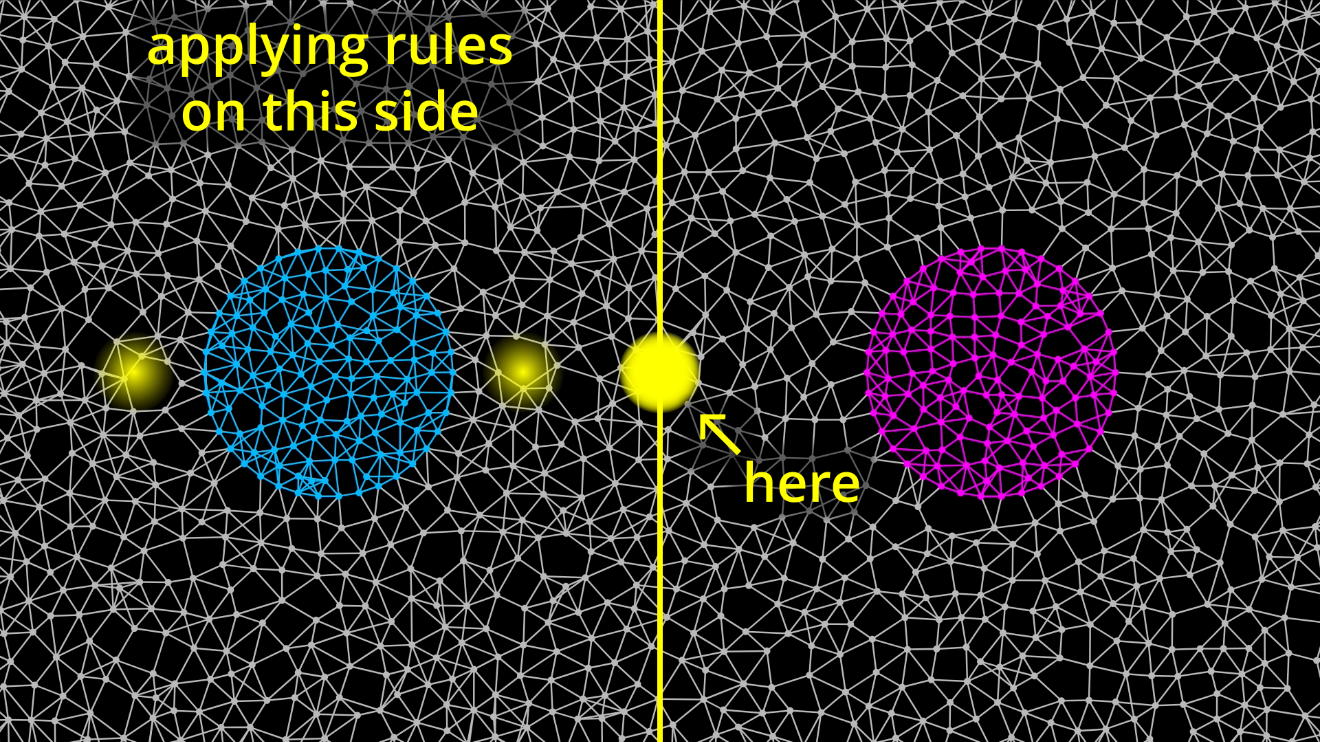
at the boundary between the pulsar’s side of the universe and the astronomer’s side of the universe.
While this went on, the astronomer would experience nothing:
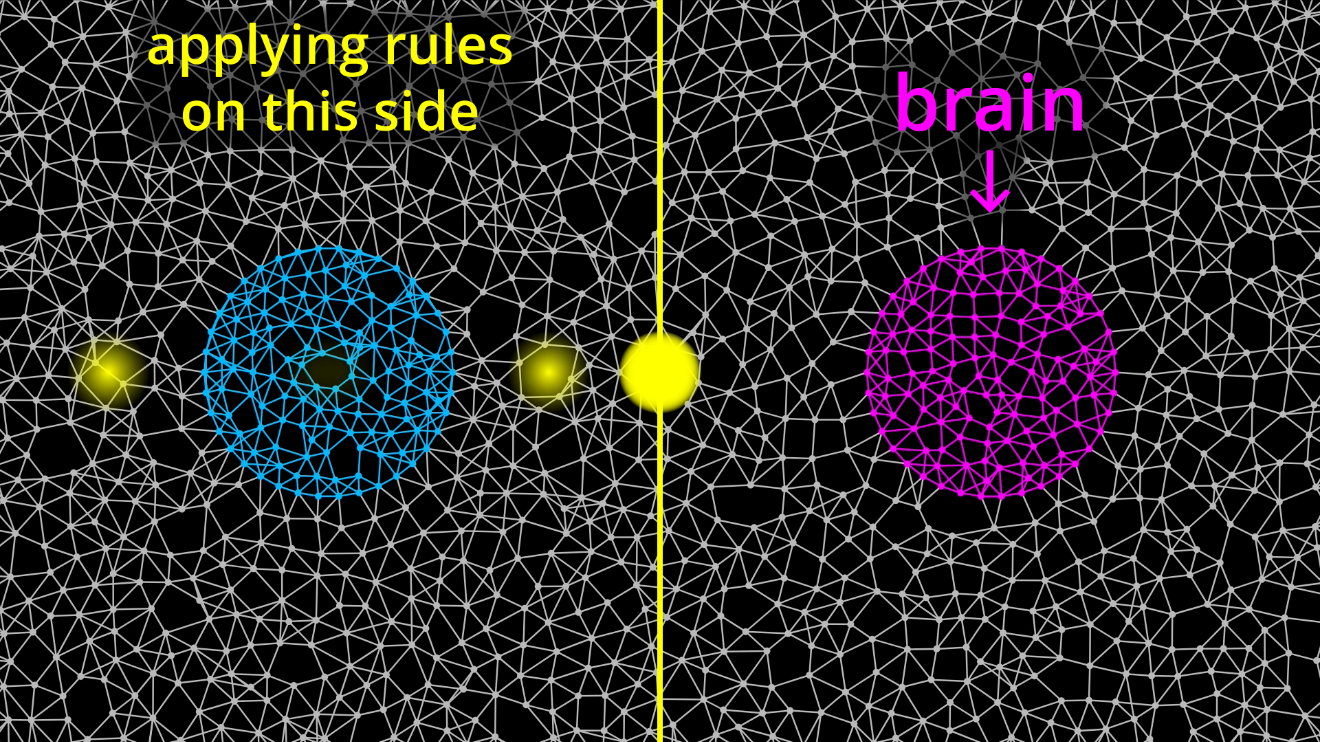
If I’m not applying rules to her side of the universe, her brain wouldn’t evolve. She wouldn’t perceive anything. She wouldn’t think anything. She wouldn’t experience the passing of time.
Then, when I switched to applying the rules to the other side of the universe, the squillion pulses would be released, all at once:
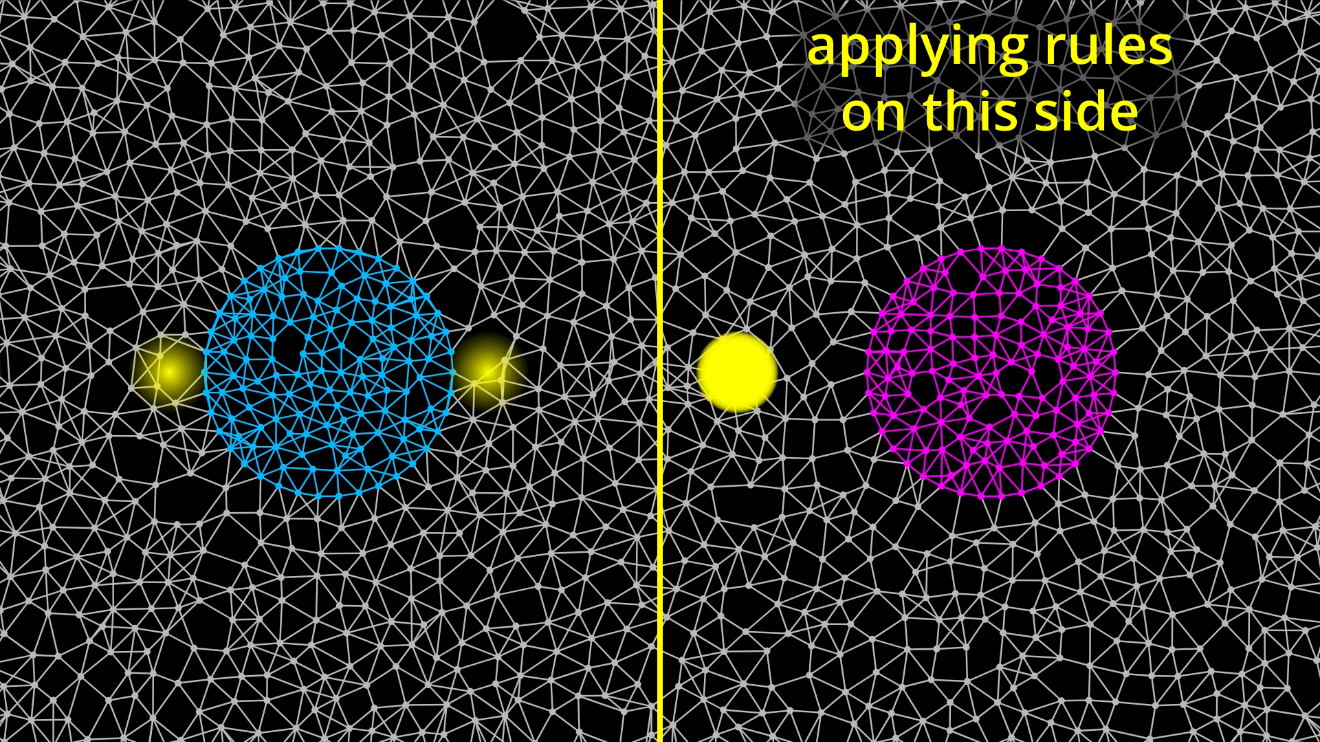
When they reached the astronomer’s brain, she would perceive those squillion pulses all at once:
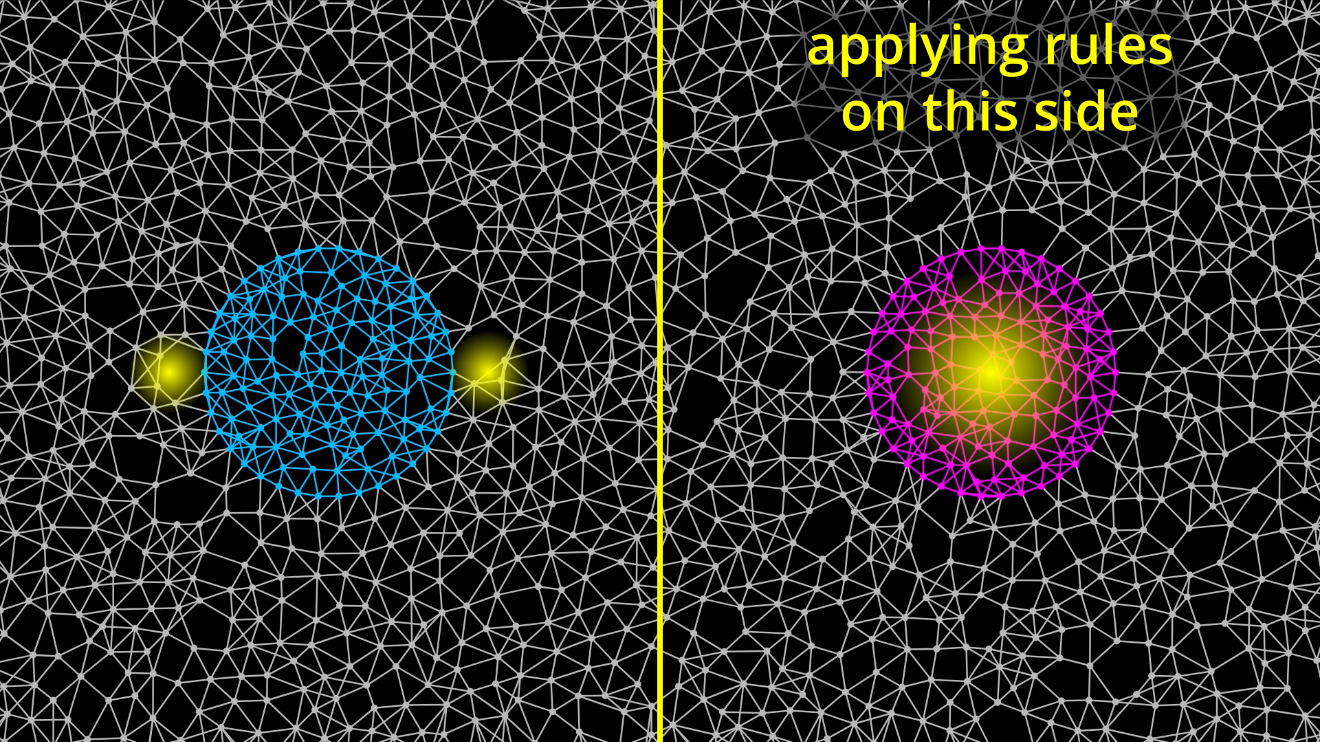
In our universe, this never happens.
No astronomer has ever perceived a squillion pulses from a pulsar all at once.
Indeed, no astronomer has ever perceived pulses from a pulsar arriving more frequently than usual, or less frequently than usual, even by the tiniest fraction.
In our universe, astronomers always perceive pulses from pulsars at precisely the same rate. If the pulses from a particular pulsar arrive at a rate of one every second, they always arrive at a rate of one every second.
Which means that what I’m doing here – applying rules a squillion times to one side of the universe then applying rules a squillion times to the other side of the universe – never happens.
Why not?
Beyond probability
If astronomers always perceive pulses from pulsars at precisely the same rate, it means that rules are applied evenly across the universe.
There’s a simple reason why this might be the case... or, at least, appear to be the case.
It’s the same reason why the oxygen molecules in the air around me are distributed evenly across the room:
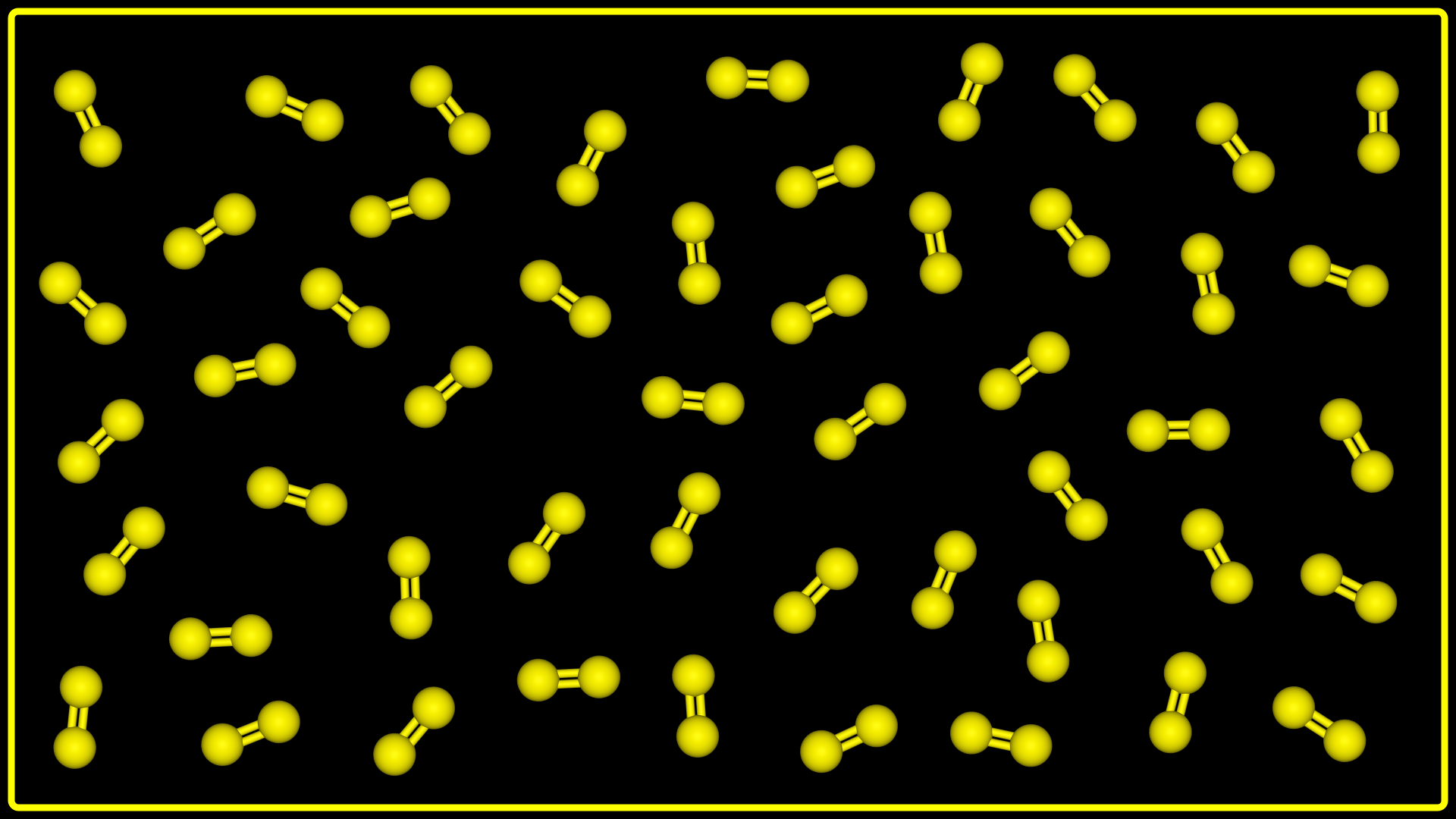
There’s nothing in the laws of physics that says that those oxygen molecules can’t, in the next moment, all be at the other end of the room:

After all, they’re all moving randomly, and there’s nothing to prevent them from all moving randomly from my end of the room to the other end of the room.
If they did, I might be in trouble.
There’s nothing in the laws of physics that says that those oxygen molecules can’t all be at the other end of the room, it’s just that it’s unlikely.
If counting on probability to save you from suffocation makes you nervous, then you might not be grasping the magnitude of the improbability we’re talking about here.
If there’s a 50-50 chance that any one of the oxygen molecules in this room is at the other end of the room, then:
- if there were one oxygen molecule in the room, there’d be a 1 in 2 chance that it’d be at the other end of the room, and
- if there were two oxygen molecules in this room, there’d be a 1 in 4 chance that they’d both be at the other end of the room, and
- if there were ten oxygen molecules in this room, there’d be a 1 in 1,000 chance that they’d all be at the other end of the room.
The thing is, there are actually 1026 oxygen molecules in this room, which means that there’s a 1 in 1030,000,000,000,000,000,000,000,000 chance that they’d all be at the other end of the room. If you think you can grasp how big that number is, you’re fooling yourself.
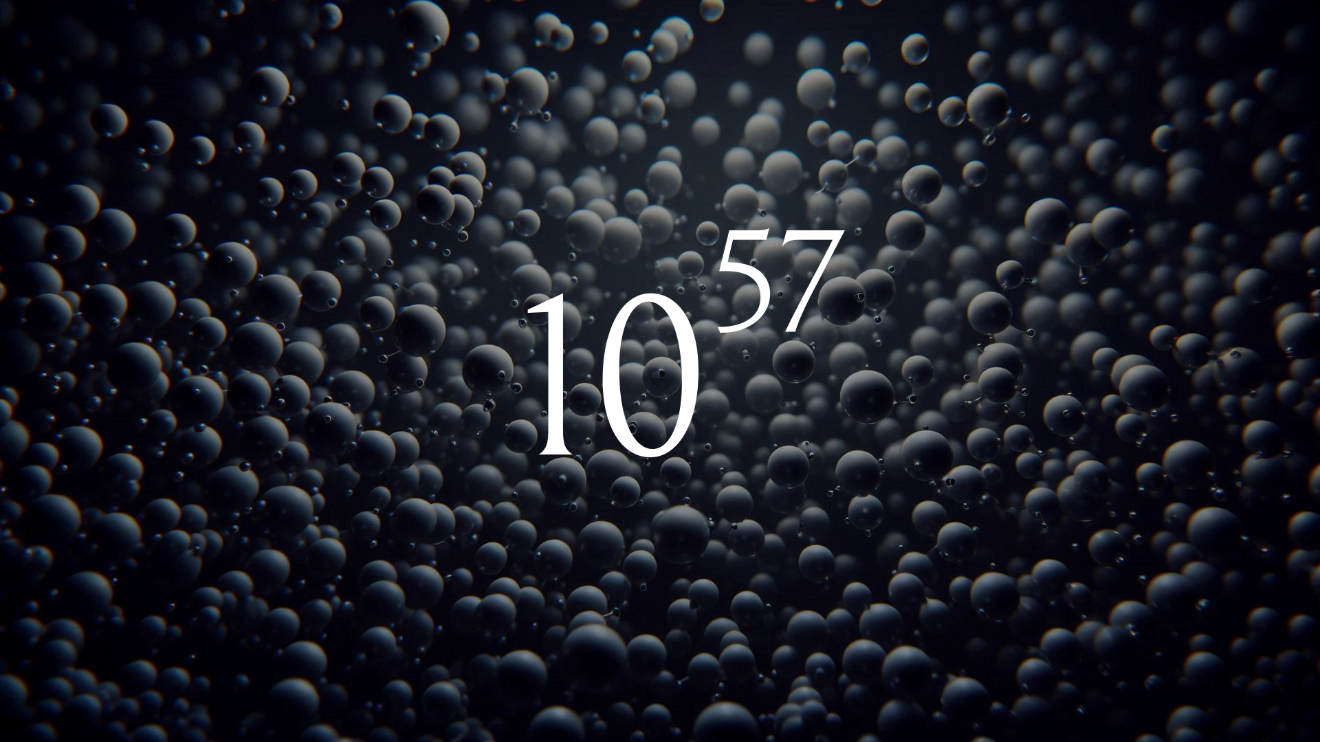
There are maybe 1057 atoms in a star.
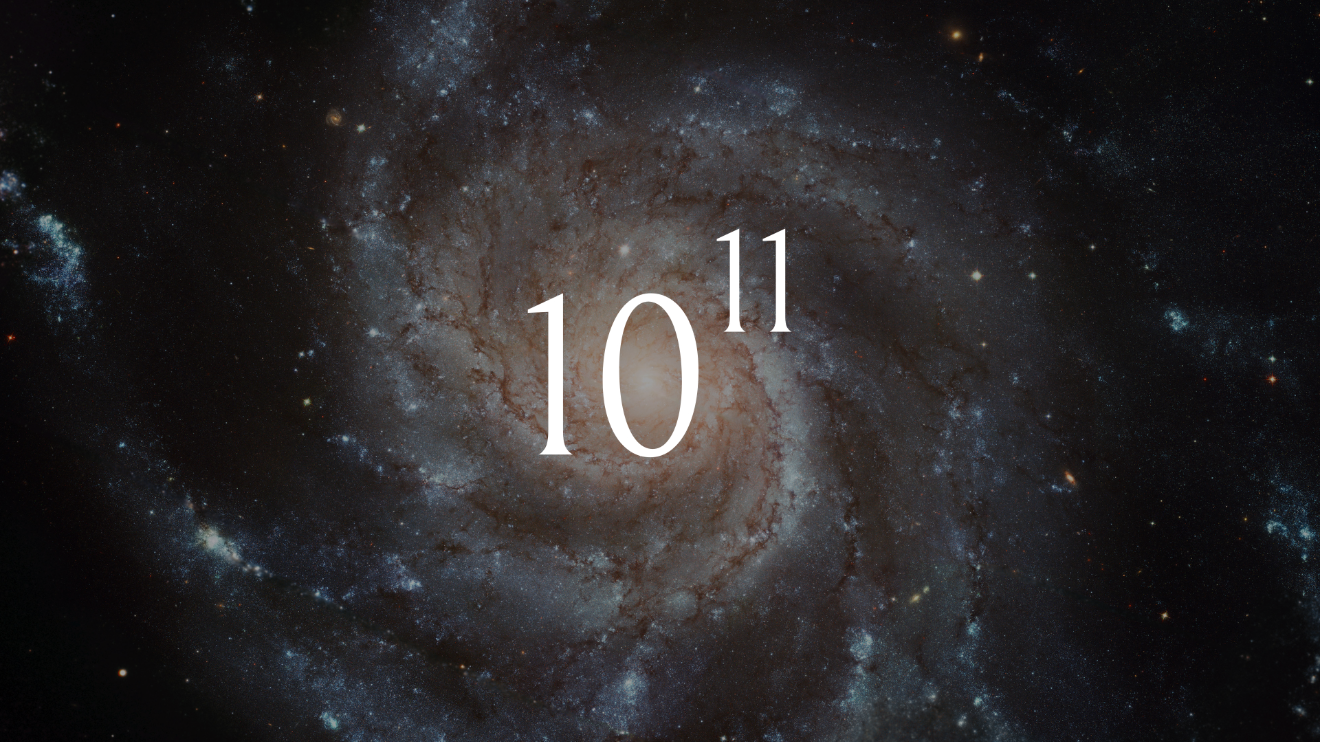
There are maybe 1011 stars in a galaxy.
There are maybe 1012 galaxies in the universe.
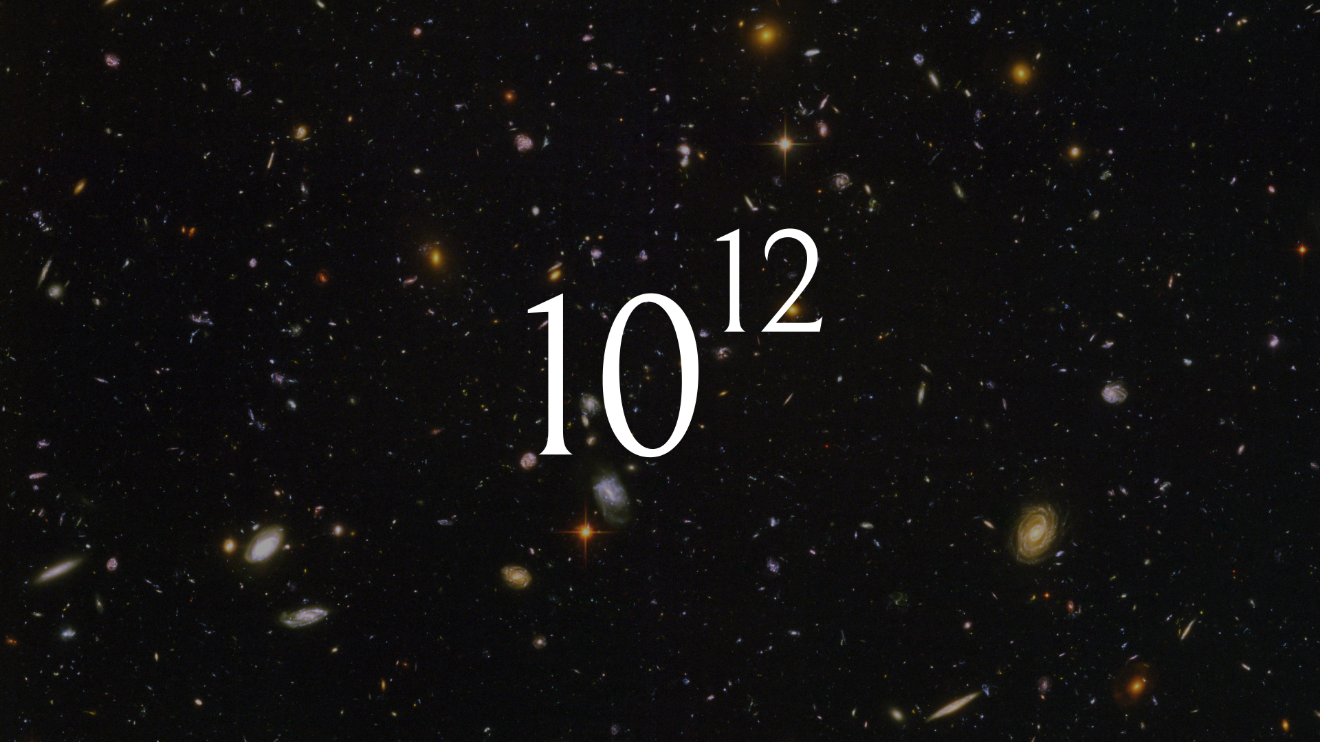
Which means that there are maybe 1080 atoms in the universe.

You’ll notice that these exponents – 57, 11, 12, 80 – are quite small compared to 30,000,000,000,000,000,000,000,000. Which means that these numbers – 1057, 1011, 1012, 1080 – are... well, there are no words for how small they are compared to 1030,000,000,000,000,000,000,000,000.
It’s more than unlikely that all the oxygen molecules in this room will, at any moment, all be at the other end of the room. Indeed, as those astronomical numbers – 1057, 1011, 1012, 1080 – show, it’s more than astronomically unlikely. It’s... well, it’s just never going to happen.
It’s the same with applying rules to randomly selected nodes and edges of the hypergraph.
There’s nothing to say that, applying rules randomly to the hypergraph, I could never happen to apply rules a squillion times in a row to the nodes and edges on the pulsar’s side of the universe, then happen to apply rules a squillion times in a row to the nodes and edges on the astronomer’s side of the universe.
It’s just that it’s unlikely.
More than unlikely.
More than astronomically unlikely.
It’s never going to happen.
This is the simple explanation for why, in our universe, astronomers always perceive pulses from pulsars at precisely the same rate.
It’s not that, applying rules to randomly selected nodes and edges of the hypergraph, it’s impossible for there to be fluctuations between the numbers of applications on one side of the universe and the numbers of applications on the other side of the universe.
It’s just that the chances that such fluctuations might be large enough to be perceptible are... well, again, there are no words for how small they are.
It’s never going to happen.
Outliers
The only problem with this explanation for the even evolution of the hypergraph is that this is not the way the Wolfram model works.
According to Stephen Wolfram, rules are not applied randomly to the hypergraph.
According to Stephen Wolfram, every possible rule is applied in every possible place in the hypergraph.
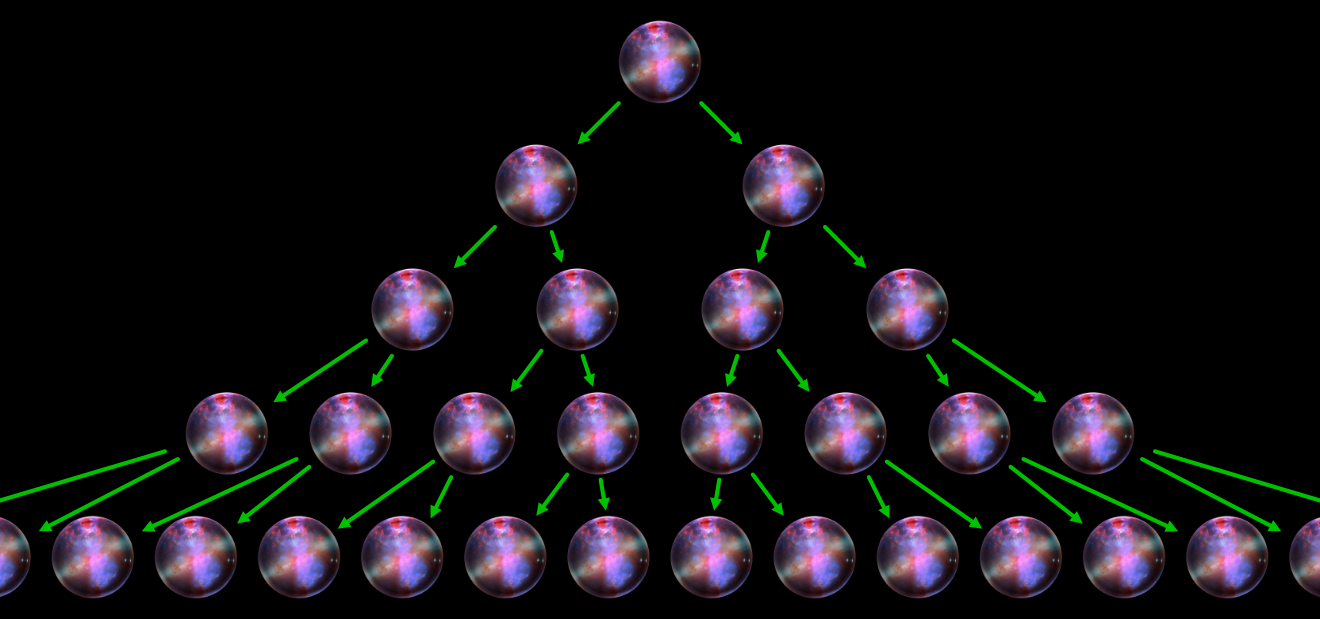
The multiway graph gives us a way to visualize this:
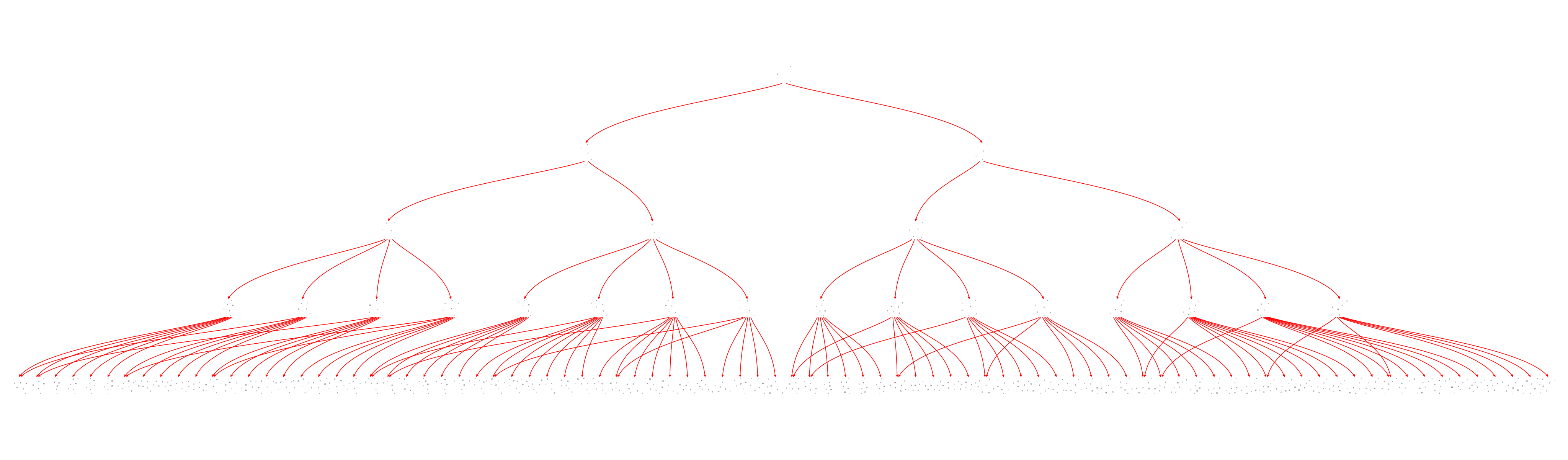
This multiway graph shows every possible evolution of the universe through the application of this rule to the hypergraph:
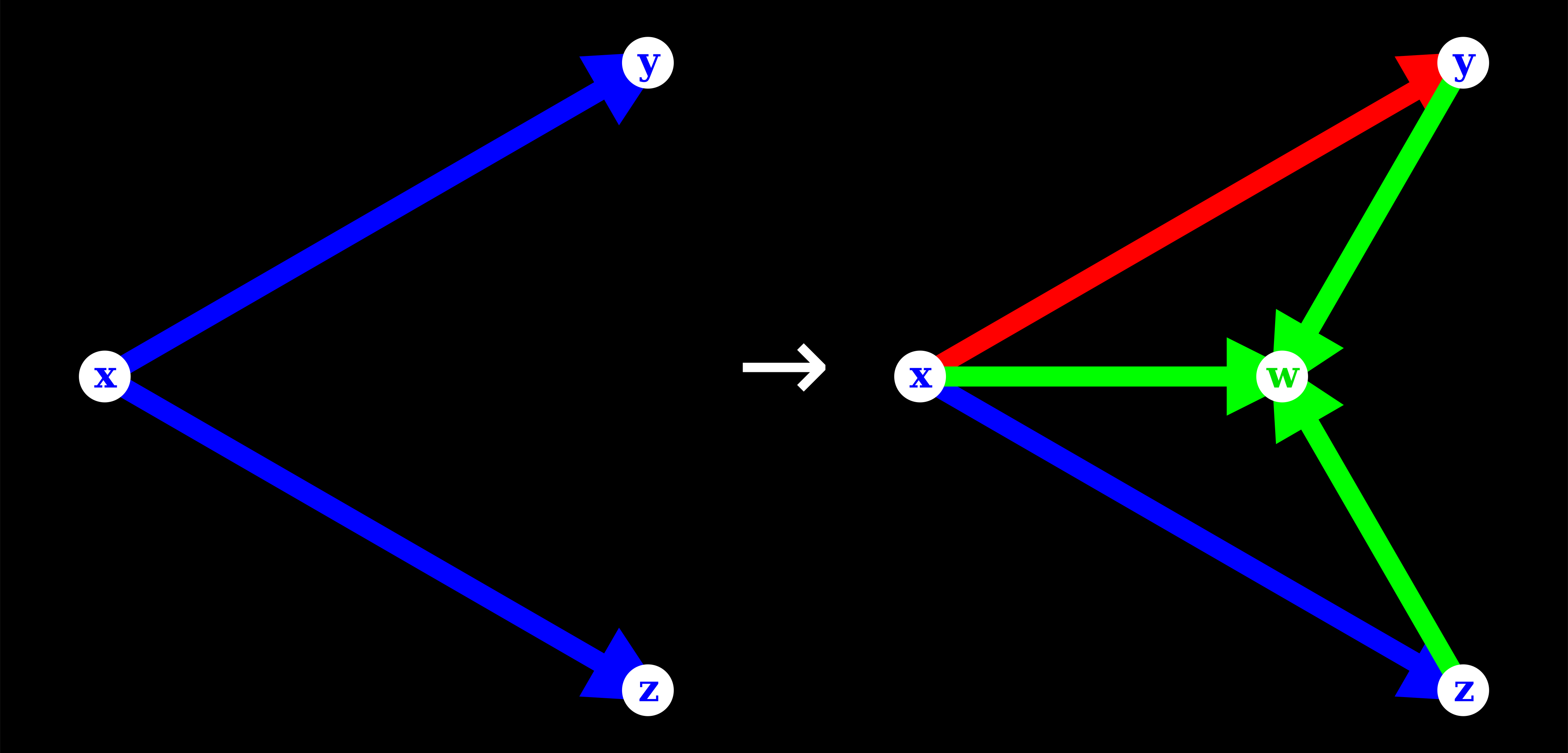
From the universe at the top, there are two possible ways we could apply the rule:
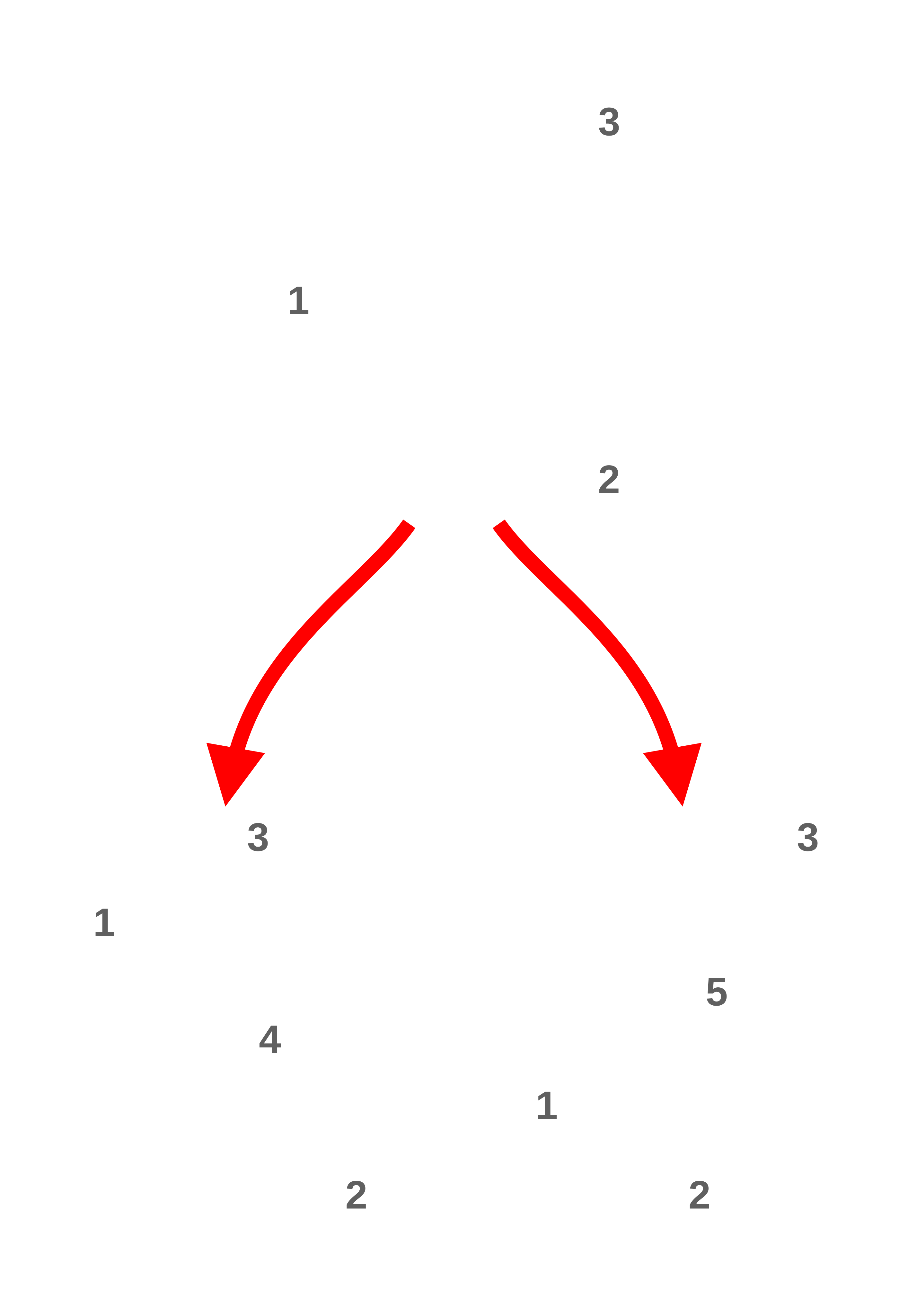
And there are two possible ways we could apply the rule to each of the two possible universes that result:
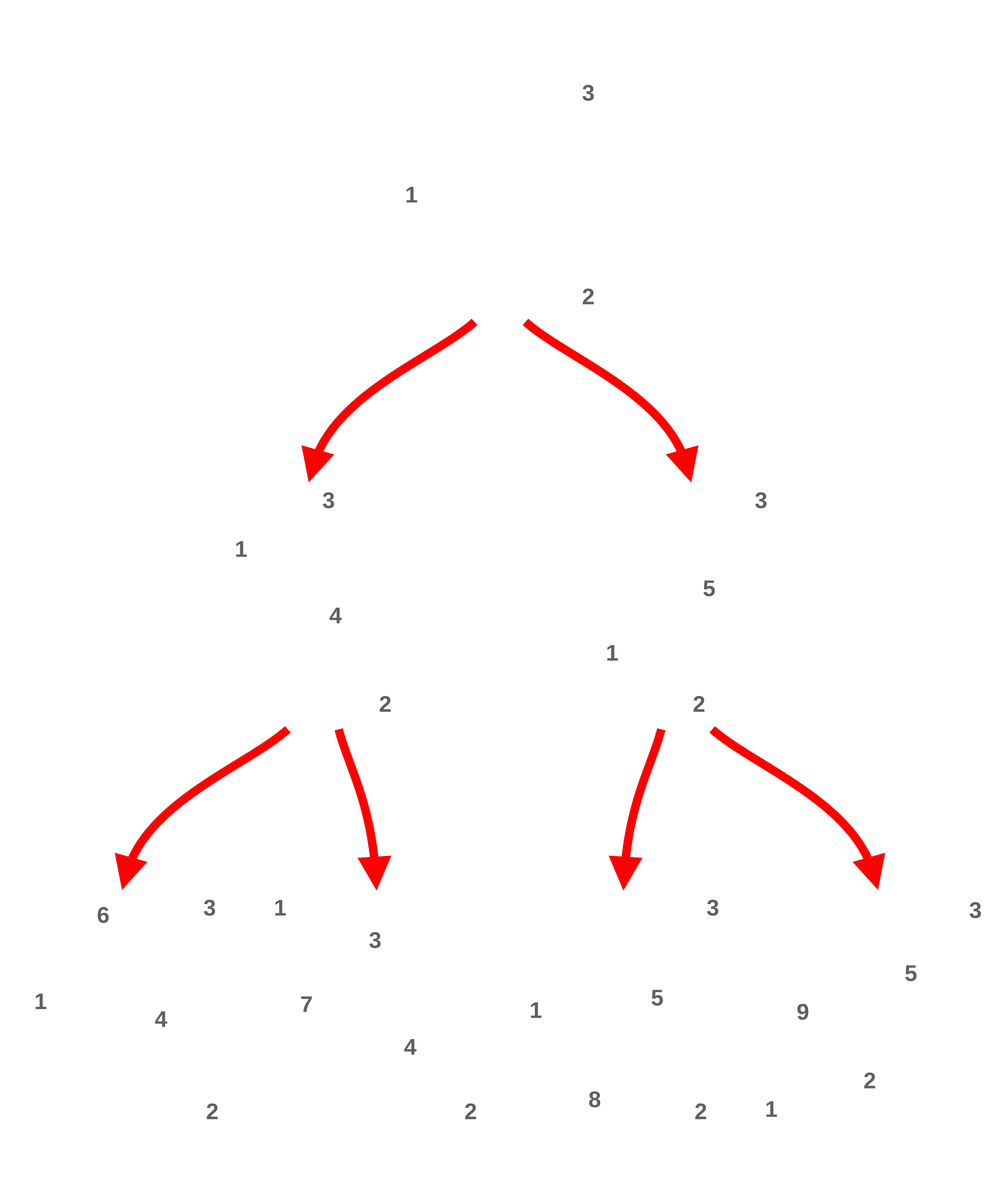
And there are four possible ways we could apply the rule to each of each of the four possible universes that result:
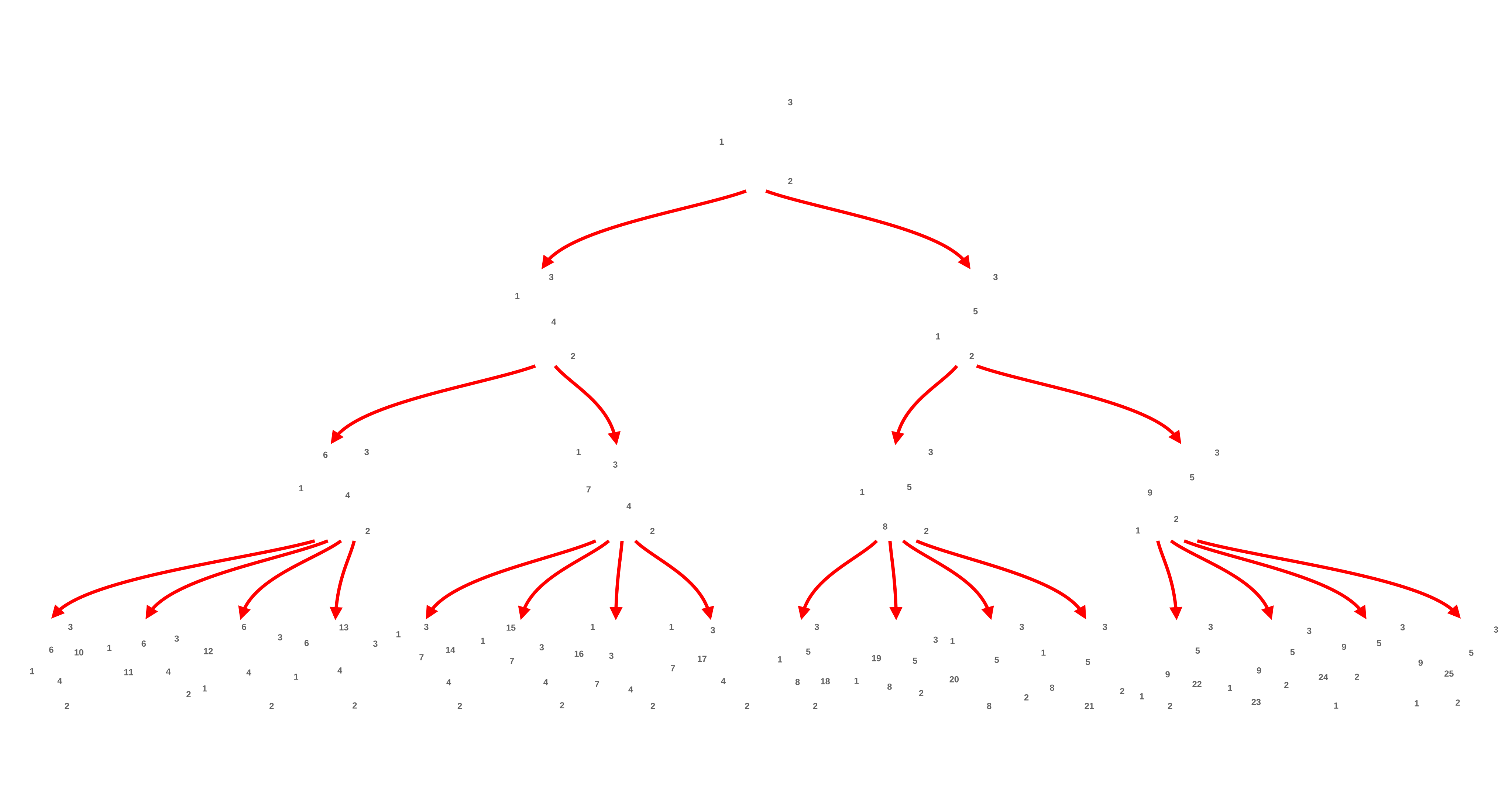
And so on:
The thing is, when we’re applying a rule to the hypergraph in every possible way, astronomically unlikely things do happen.
There might be dozens of universes in which nothing weird happens:
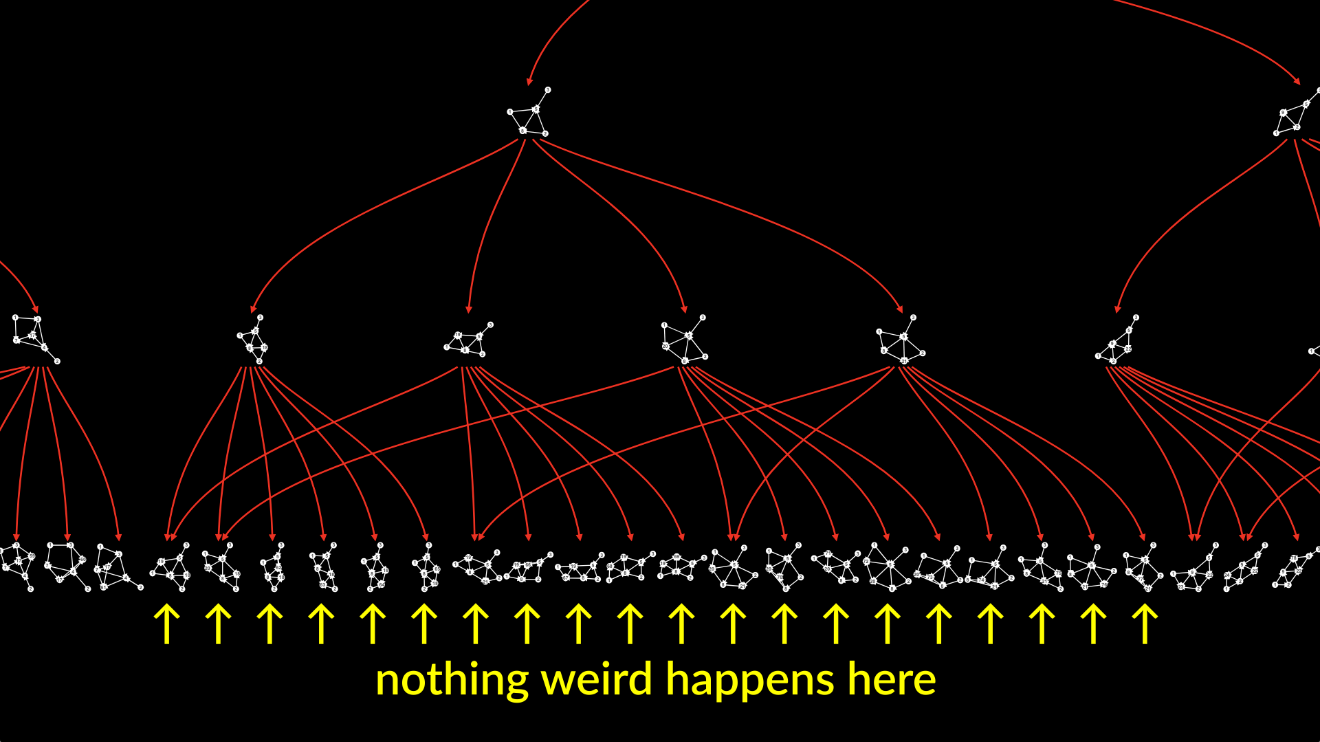
but there are outlier universes in which weird things do happen:
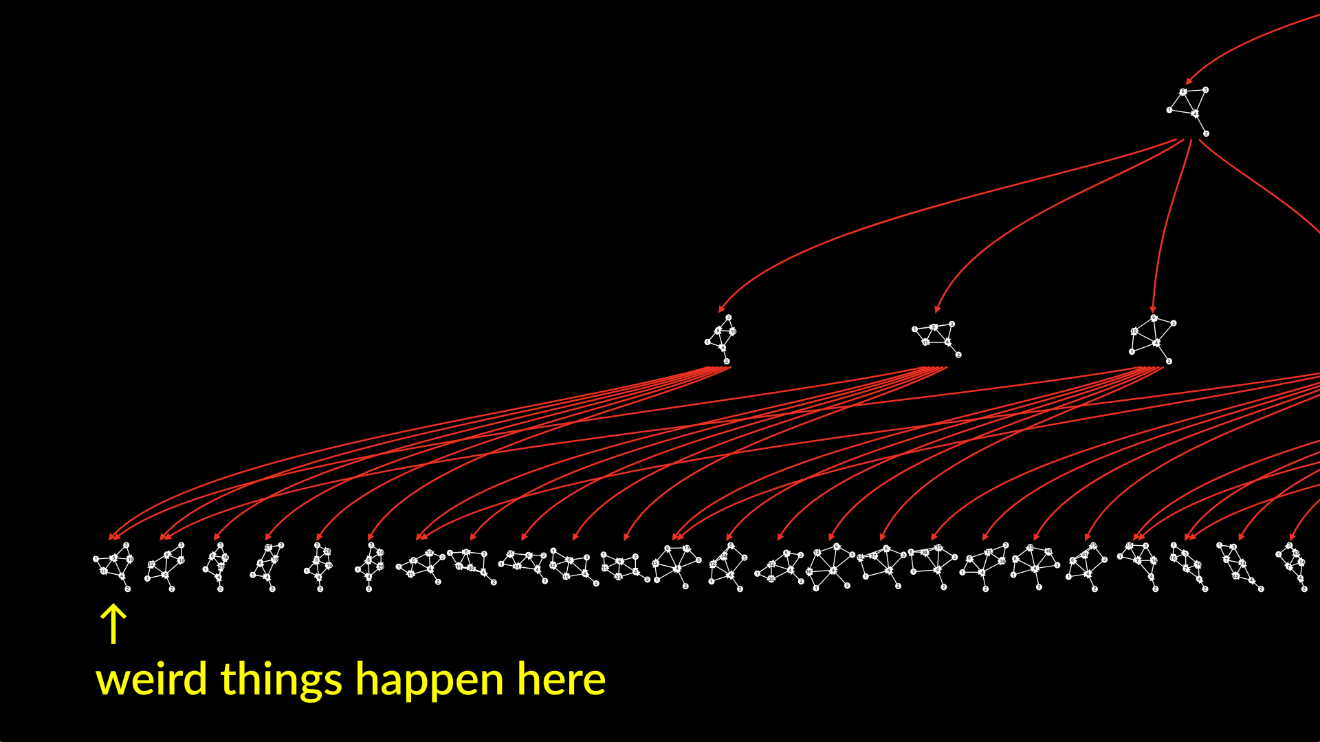
universes in which, for example, the rule is applied a squillion times in a row to the nodes and edges on the pulsar’s side of the universe:
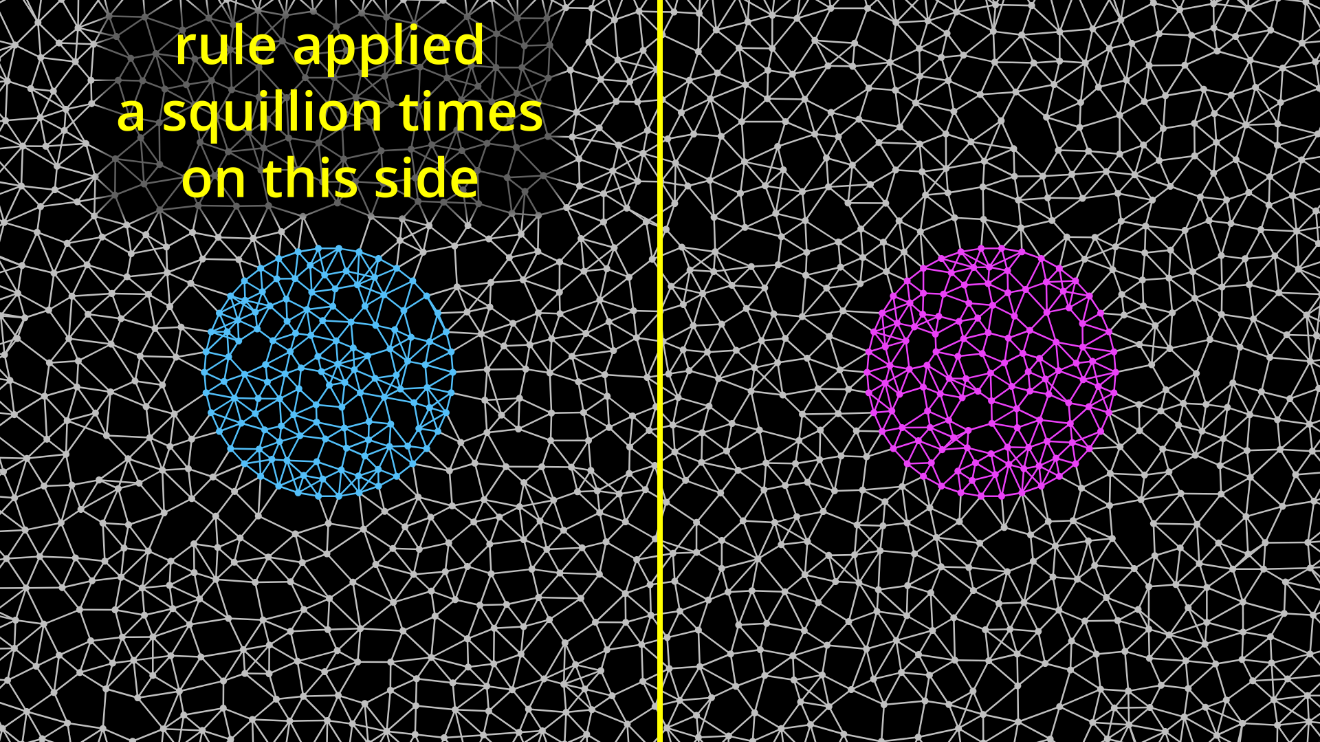
then a squillion times in a row to the nodes and edges on the astronomer’s side of the universe:
So maybe I should be worried about getting enough air.
There might be 1030,000,000,000,000,000,000,000,000 universes in which the oxygen molecules are evenly distributed across this room:
but maybe I’m in an outlier universe in which all the oxygen molecules are at the other end of the room:
As I say, applying rules to the hypergraph randomly, this is more than astronomically unlikely, it’s never going to happen.
But applying every possible rule to the hypergraph in every possible way, it is going to happen.
The question is, am I in one of those universes in which it does happen?
And if not, why not?
Why are we here?
In a way, this is the question of Wolfram Physics:
Why are we in the universe we’re in?
If we’re in an outlier universe – one of the universes in which the are rules are applied a squillion times to one side of the universe then applied a squillion times to the other side of the universe – then why?
If we’re in a non-outlier universe – one of the universes in which the rules are applied evenly across the universe – then why?
If we’re in an ordered universe – one of the universes where pulsars pulse at regular rate, photons travel in straight lines and astronomers have coherent experiences of time – then why?
If we’re in a chaotic universe – one of the universes where electrons degenerate, molecules detonate and mountains dematerialize – then why?
Why are we in this universe...
...rather than that universe?
Three different worlds
Here are three possible answers to that question.
Thesis #1
Every possible universe exists.
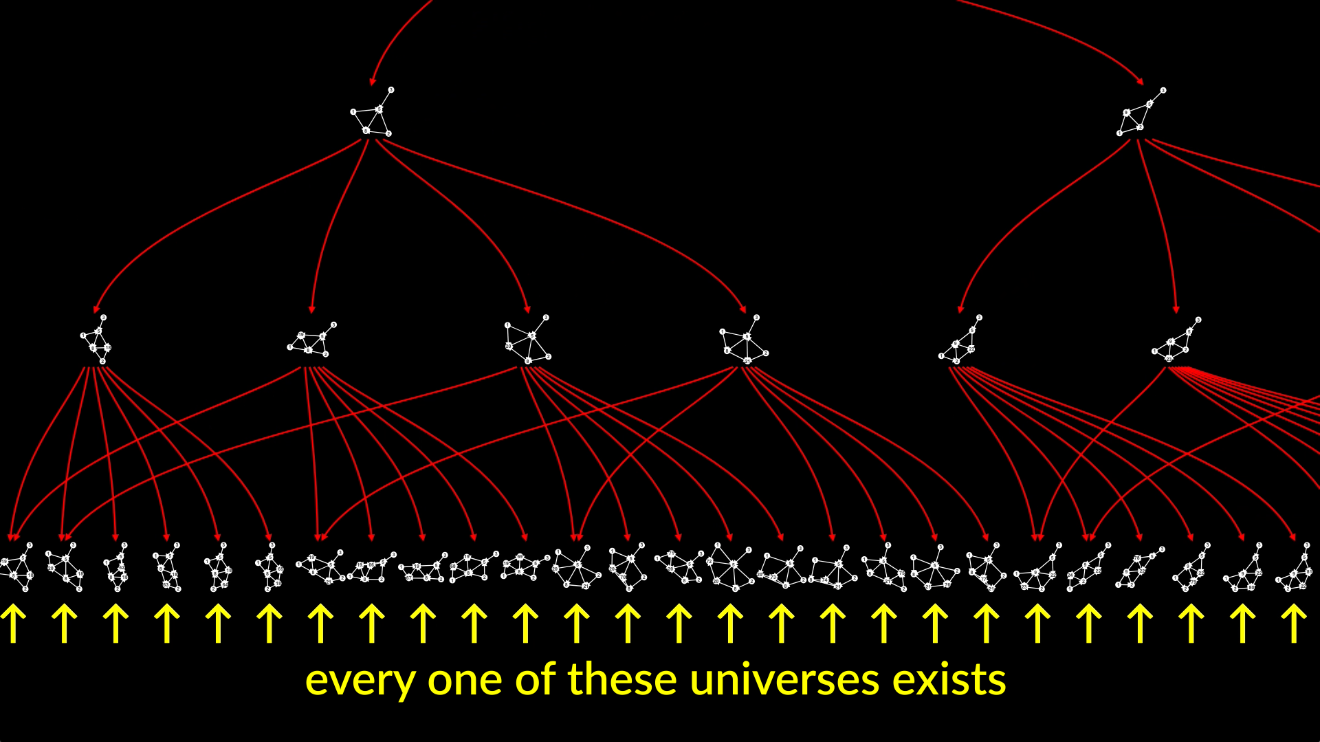
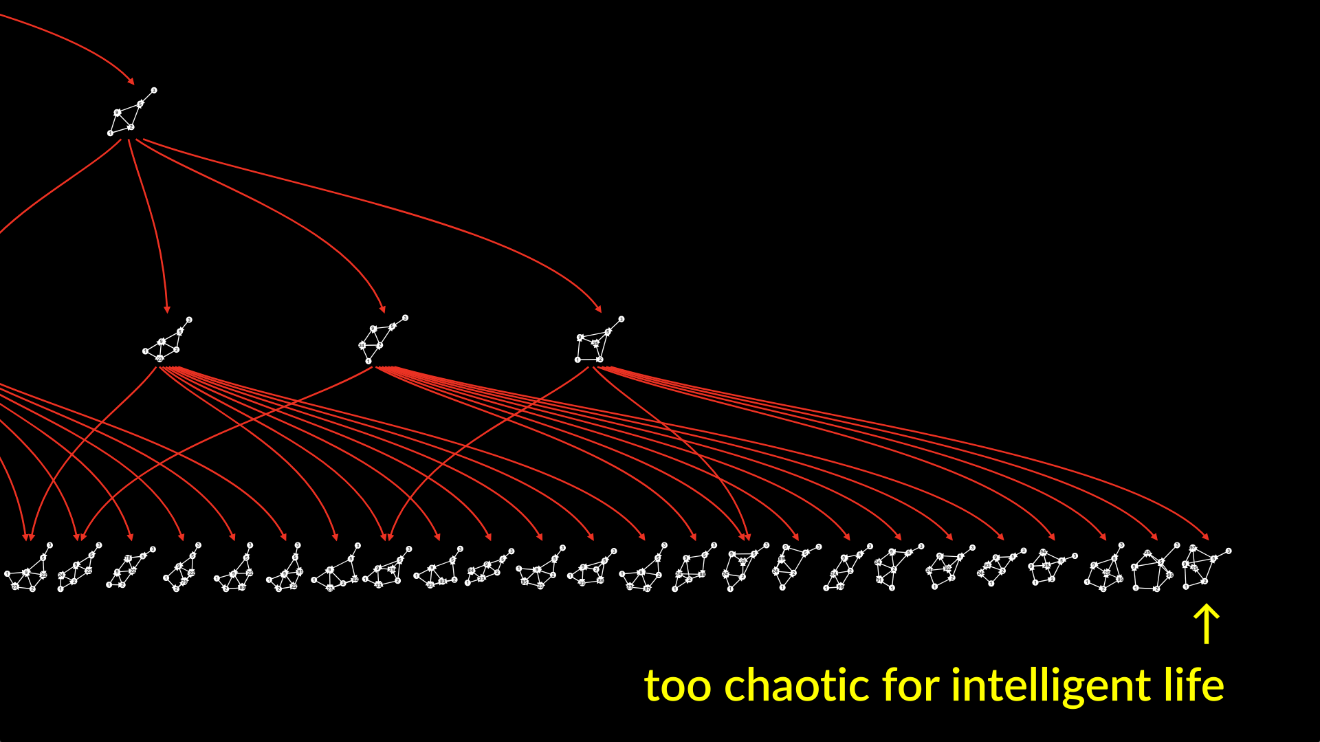
Outlier universes exist, but they’re too chaotic for intelligent life to evolve, so there’s no one there to observe them.
Non-outlier universes also exist, and they’re ordered enough for intelligent life to evolve. The intelligent beings that do evolve there observe their universe to be peculiarly ordered, and they make YouTube videos wondering why.
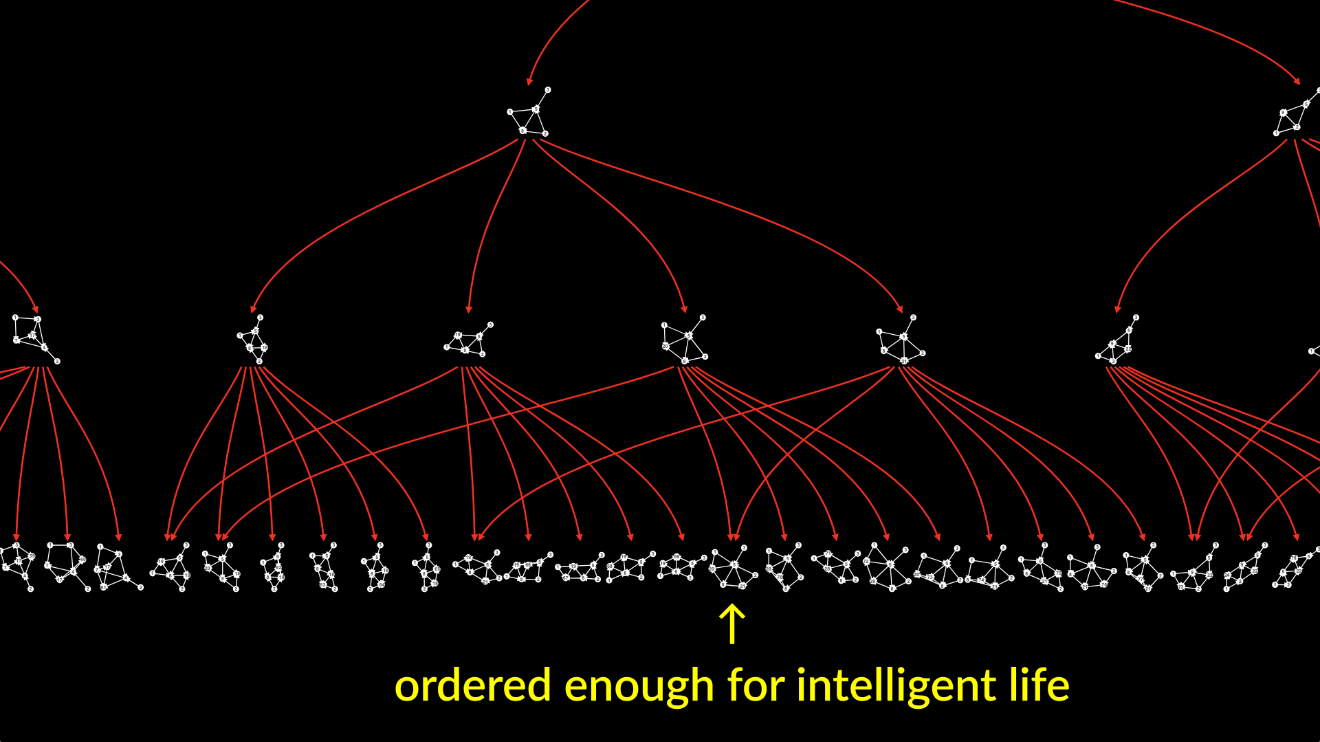
This thesis is a variation of the Anthropic Principle.
In the next video in this series, I’ll make a case for why it’s wrong.
Thesis #2
Every possible universe exists.
Every possible observer exists.

Some observers, occupying a particular position in rulial space, observe the universe to be simple: ordered, three-dimensional, with persistent particles in a smooth manifold and well-defined laws of physics.
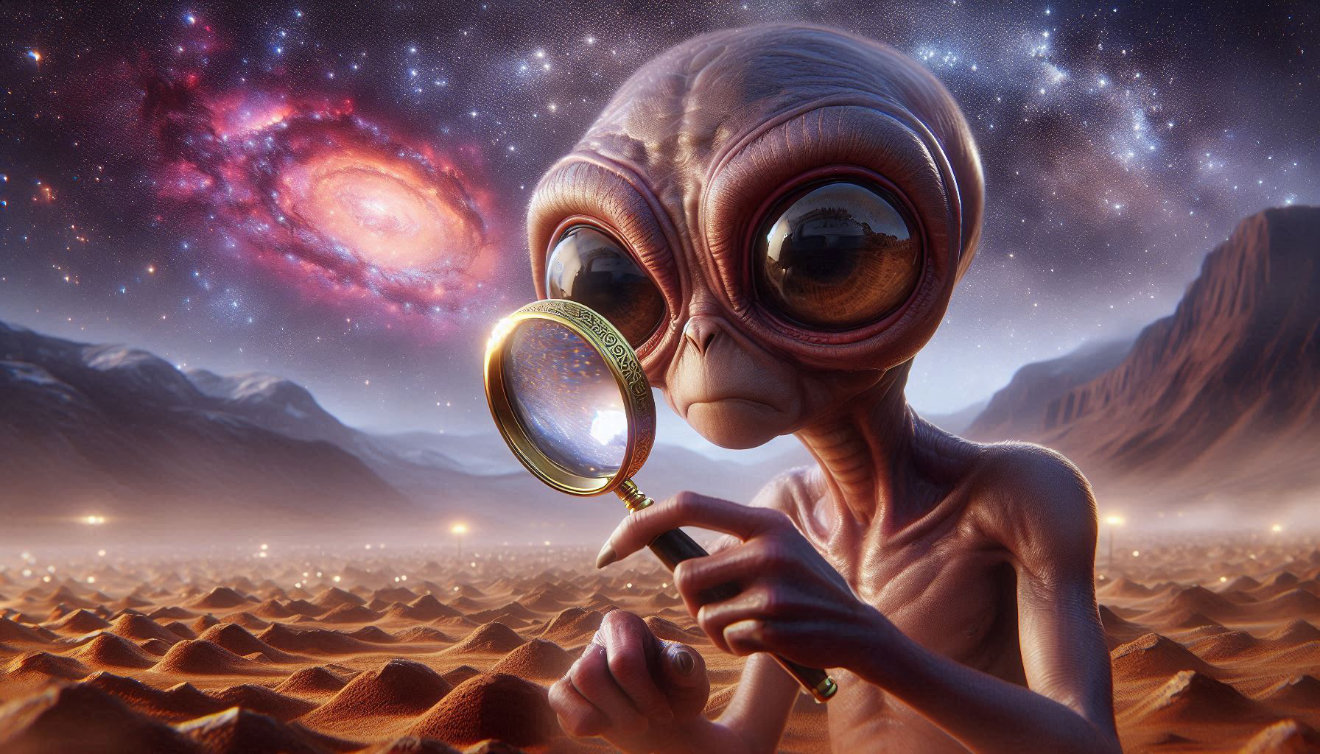
Other observers, occupying a different position in rulial space, observe the universe to be complex: chaotic, 7- or 19- or 3.37-dimensional, with wild perturbations in a turbulent manifold and no well-defined laws of physics.
We observe the universe we observe because we are the observers we are.
This is Stephen Wolfram’s answer to the question of why we’re in the universe we’re in.
In the video after next in this series, I’ll explore Stephen’s fascinating idea that there’s something about us as observers, something about the way we equivalence different paths through the multiway graph into a single thread of time, that allows us to condense the chaos of the ruliad into a coherent universe.
But there’s another possible answer to the question of why we’re in the universe we’re in.
Thesis #3
Not every possible universe exists.
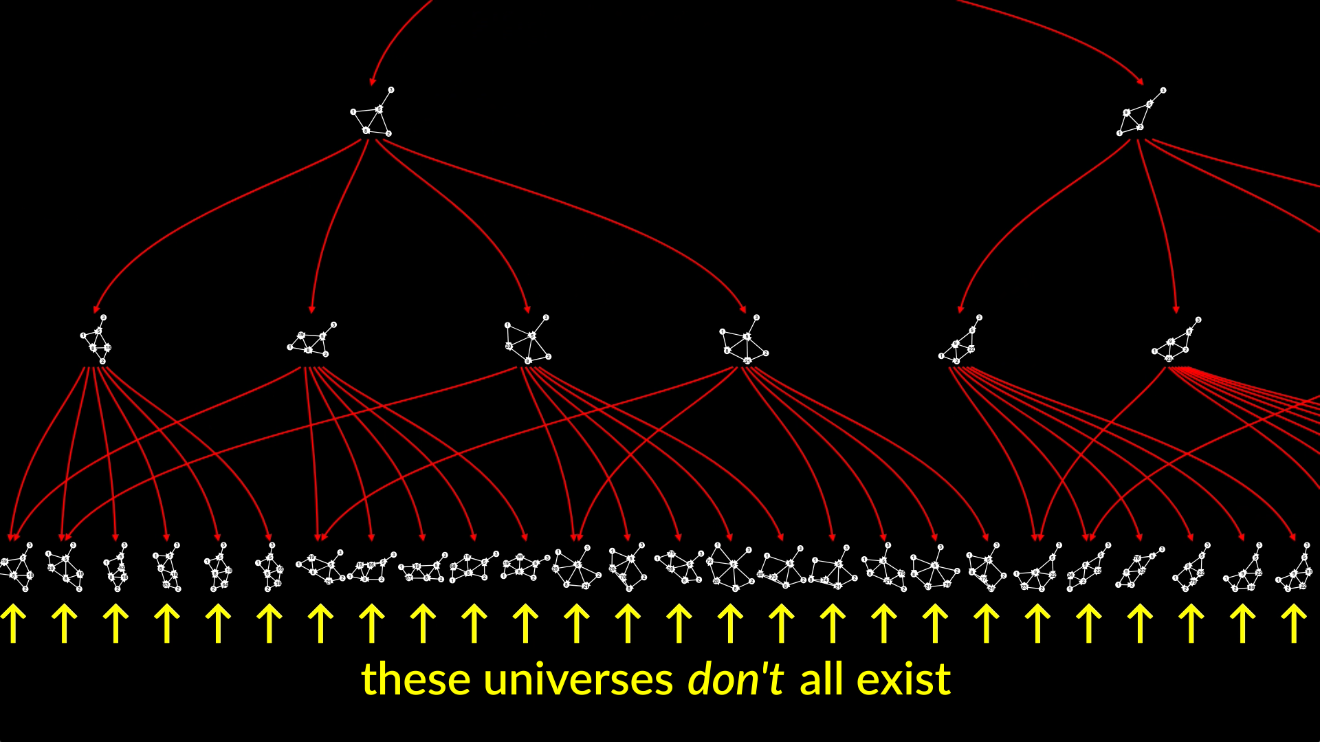
There’s branching of the multiway graph.
Some of the branches come back together, and reinforce each other.
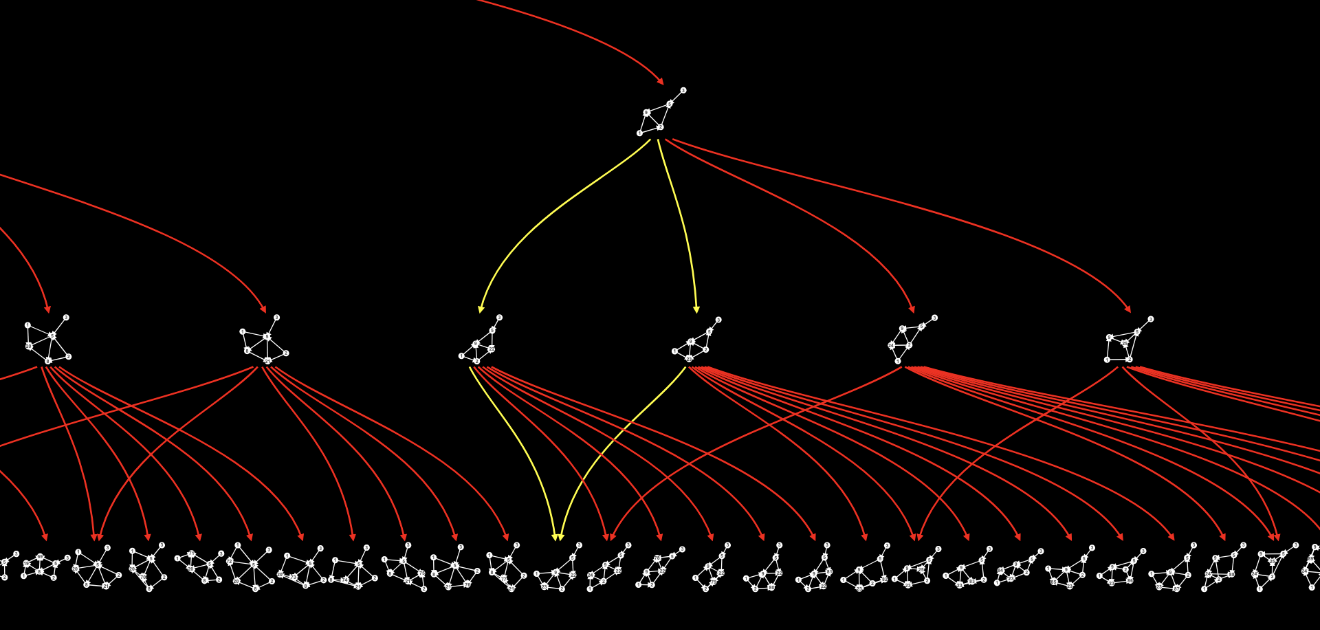
Other branches stay solitary, and wither away.
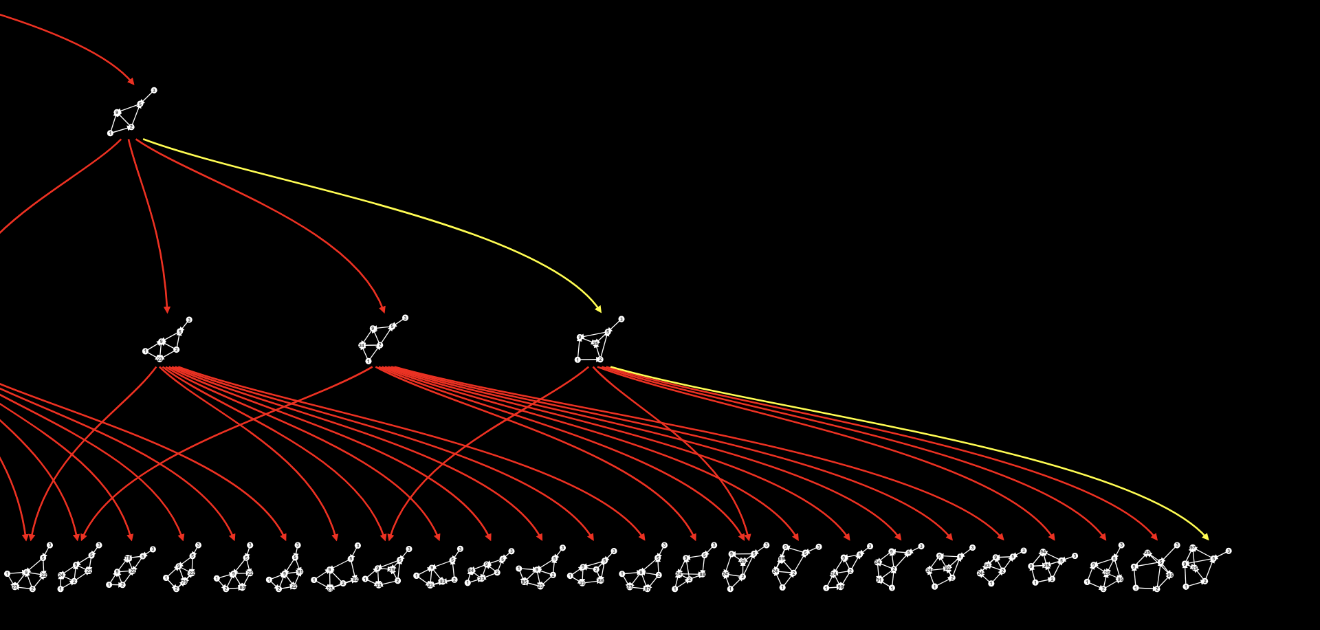
Outlier universes, which can be reached only via a few, exceptional paths through the multiway graph, don’t happen.
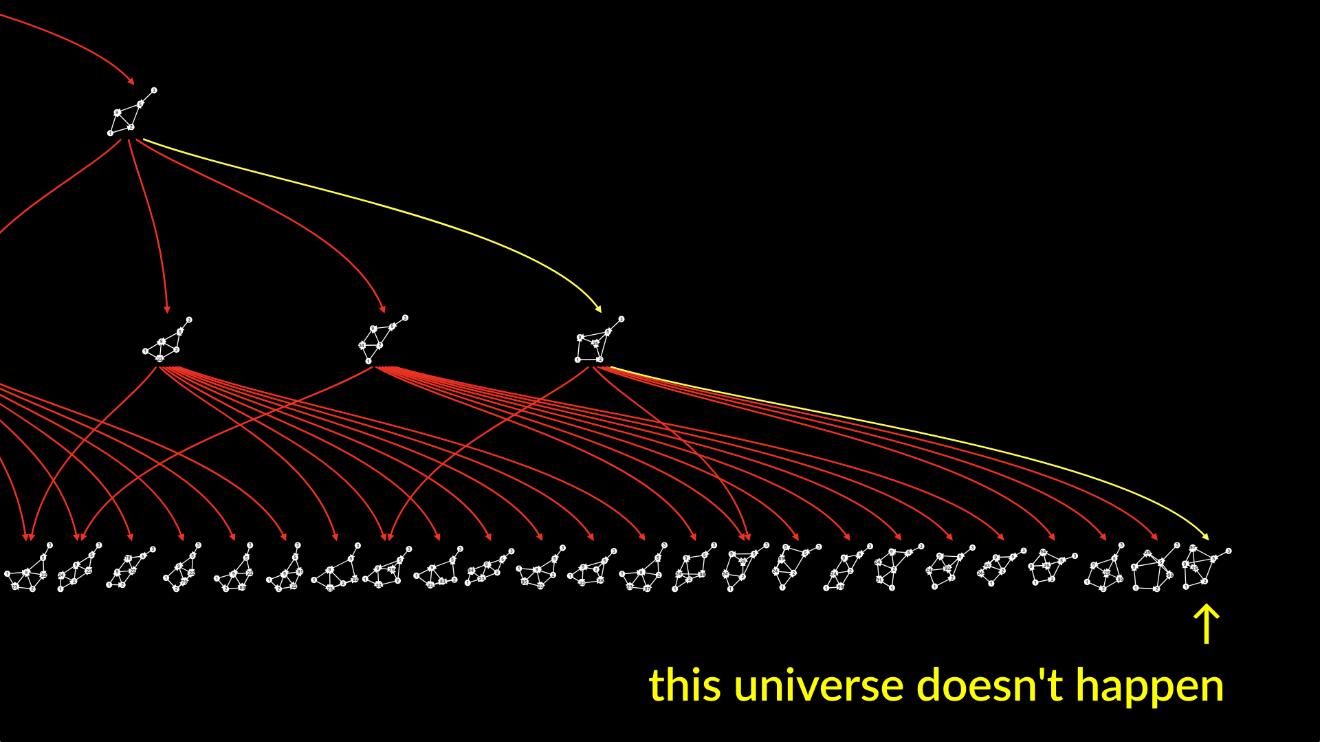
Non-outlier universes, which can be reached via a squillion different paths through the multiway graph, do happen.
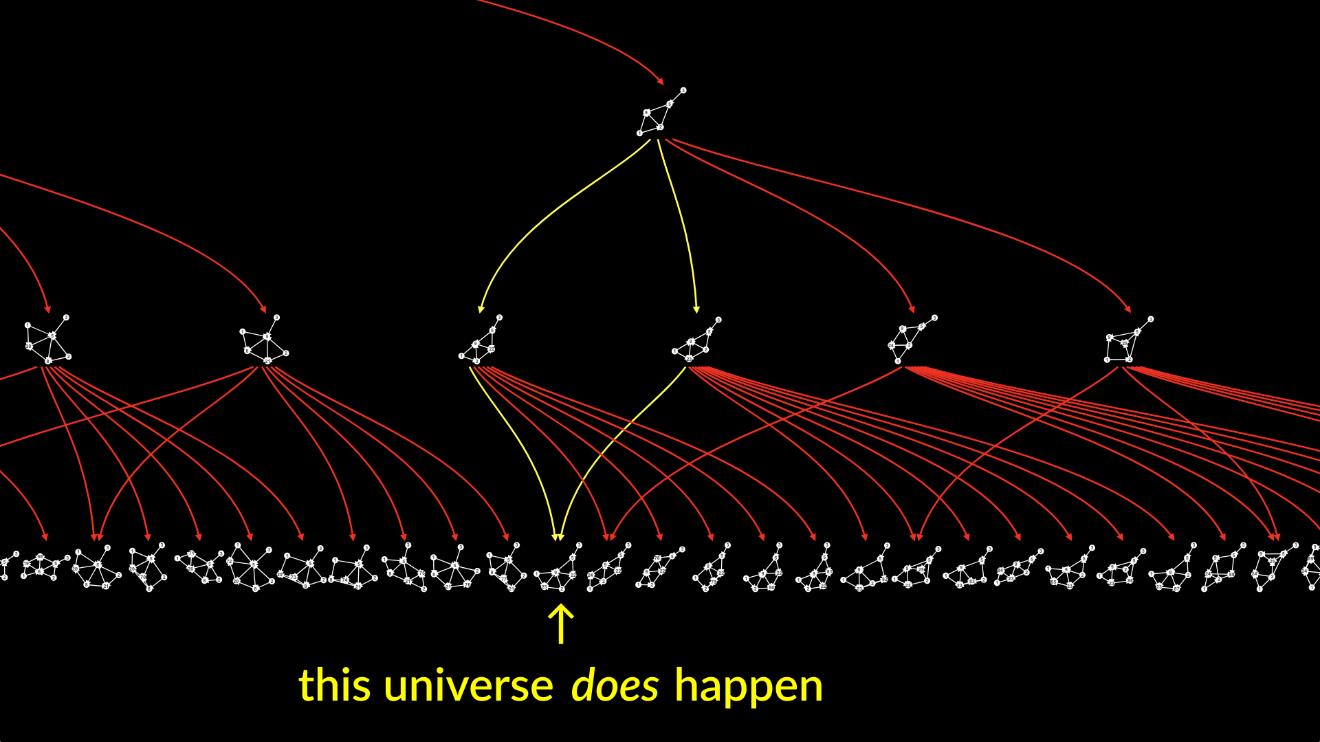
This thesis is in some ways similar to the much-maligned Copenhagen Interpretation of quantum mechanics.
It doesn’t require an observer to collapse the wavefunction, but it does require that we accept that not every possible universe exists, that there are probabilistic laws of physics that determine which universes do exist and which don’t.
In the video after the video after next in this series, I’ll explore how a theory based on this thesis might work.
Treacherous territory
I’ll admit, working on this article, I’ve felt as if my head were about to explode.
This is treacherous territory.
I suspect that the reason it seems so head-exploding is that we’re close to the core questions here, not just of Wolfram Physics, but of physics.
These questions – Why are we in the universe we’re in? Does every possible universe exist or does only one universe exist? – are the most fundamental questions in physics.
We’re closer than ever to the answers.
—
Credits
- Image of Messier 101 galaxy by ESA/Hubble licensed under CC BY 4.0
- Image of galaxies by NASA, ESA, S. Beckwith (STScI) and the HUDF Team licensed under CC BY 4.0
- Retina image by د.مصطفى الجزار licensed under CC BY-SA 3.0